
Congratulations on taking the first step to bring AI into your daily practices by downloading or viewing this guide. To ground us in the current state of AI for Legal, I would (if you’re old enough) cast your mind back to 1995, when Windows’ launched it’s 95 Operating System. This was a monumental moment as computers suddenly became more accessible for the average user, and sparked the next 30 years of computer advancement.
The parallels with that moment and today with AI, are extremely close. AI has been bubbling for a few years and it has reached a point whereby millions of people across the globe use AI as part of their daily practices. For Lawyers, particularly in the finance industry, it’s harder than other professions to shift habits with the quantity of work asked of them. On top of this, the expectation of the quality of work is extremely high, with sometimes huge risk profiles. But for me, this is the exact reason why AI use will benefit lawyers more than the average profession.
In this guide we are going to cover how to best leverage free and paid for AI tools, and the things you could be doing with the AI to get benefit every single day.
Overpromising with legal AI and the dangers
Over the last 12 months, there’s been many promises of legal AI to replace a lawyer, interact with the other party’s AI and negotiate contracts to a middle ground in seconds. Ultimately, I feel the promises have gone too far and created unrealistic expectations that (currently) cannot be met, which fuels disappointment around legal AI as a whole. .
Are the LLM (Large Language Models) available in 2024 really good enough to negotiate a contract to the level a Lawyer would expect? Frankly, no.
If there is 10% error, or even 5%... would an internal legal team take that risk? No.
I see a real danger in that lawyers have been promised that automated, human-less contract review is here. That they then use tools which can’t deliver and consequently build an impression that AI is useless. This stops adoption, and ultimately slows down the development of the profession.
Luckily, there’s a better way…
How to get started
Instead of overpromising the capabilities of legal AI, I believe we should focus on the strengths that current AI delivers. This means asking experts what AI is flawless (or almost at least) in 2024, and building relevant use cases around it.
That’s exactly what we’ve done below.
All of these things can be done through open source tools like ChatGPT, Claude and Gemini. You can also use plugins through platforms like Miramis (formerly Pocketlaw) and other CLM/Legal AI providers. The benefits of paying extra for a platform like thesel are threefold:
Security and confidence that information won’t be used to train future Ai models
AI is intuitively integrated into the flow of work, with better user experience and less clicks
The models will be more fine tuned, potentially slightly more accurate and certainly more relevant
However, with that said, this whole exercise isn’t about buying the fanciest model, but to teach people how to use AI before buying the tool. For example, think fishing. Let’s teach people how to fish with simple free tools before we go spend big on a new fishing rod.
5 ways to use AI today
Summarise:
One great area that AI can support is summarising and synthesising information for you. Imagine you’ve got a 100 page complex financial contract and you want to get a breakdown of it instantly, it’s a huge time saver.
Now the tips. One thing I wouldn’t do is open up Chat.GPT, upload a contract and ask AI to:“Please summarise this document for me”.
There are multiple issues in this approach. Firstly, the AI doesn’t know the context in which you want to summarise, who you are, what you care about etc. This means that when it generates its response, it will aim to meet a response which is most acceptable and likely that is aimed at a layman.
The second issue is around length. Sometimes you might want 50 words, 500 words or 5000 words. You might want bullet points, you might want a table, you might want a paragraph. These things are incredibly important to bear in mind when you are asking the question, as if you don’t know what you want then you will get something generic.
So this is what you need to do, be specific as possible in the question. See an example below:
Please review the document and tell me the following bullet points with headings
The liability clause and cap stated in 100 words
The length of agreement, whether it has auto renewal, when we need to give notice, and how much it's going to cost in 100 words?
Any force majeure clauses and what would be covered within that in 50 words?
Governing law in 10 words
Publicity and Marketing use of logo in 40 words
Here we offer as many “guardrails” as possible to give the AI the best chance at summarising it as you would wish. Try it 5/6/7 times on the same document, review the results and tweak the prompt to be more effective. When you nail the prompt, save it and store it to use it on future documents.
Comparisons
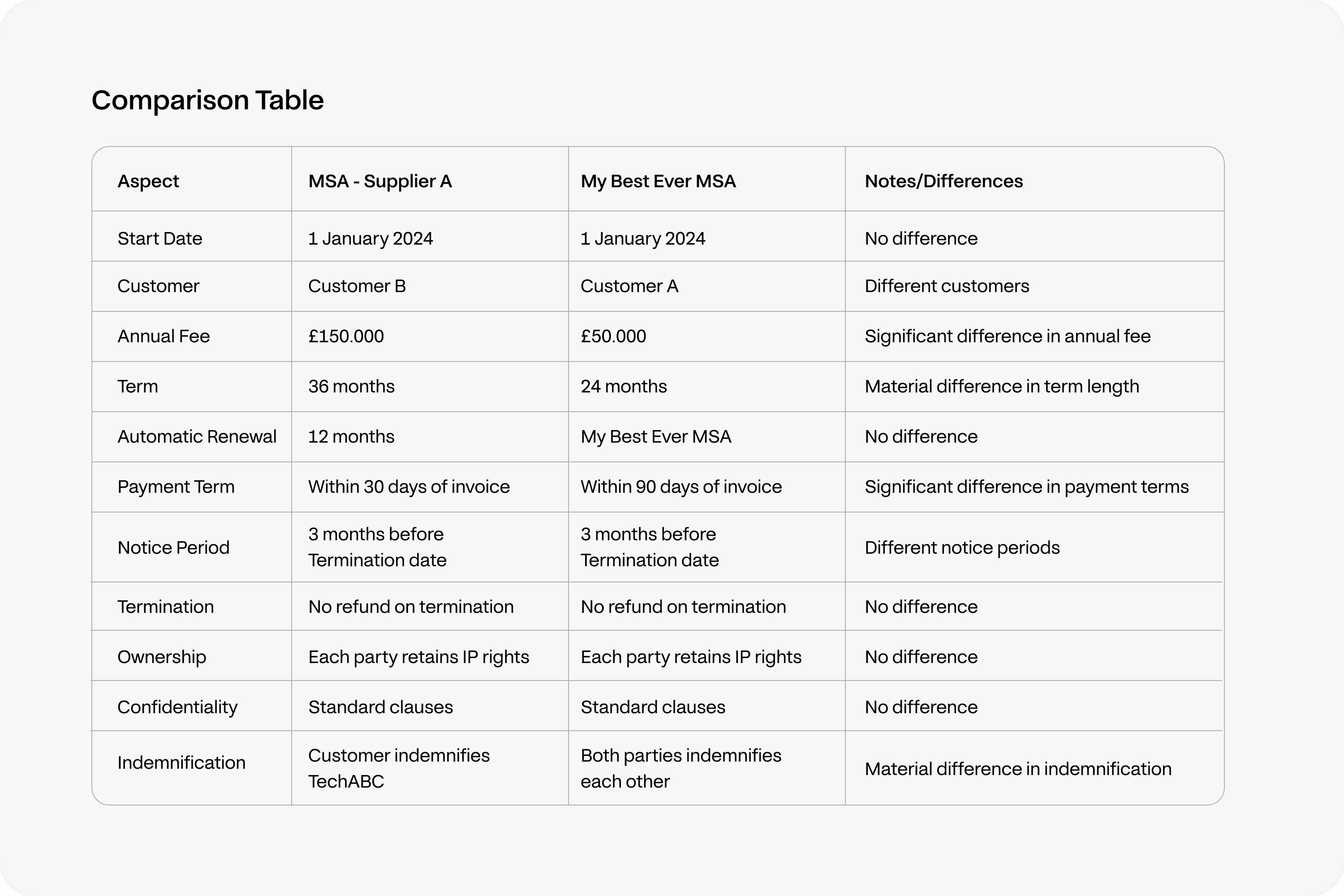
This might be the easier option of all, and somehow delivers one of the biggest outcomes. Let’s say you’ve negotiated your best ever supplier agreement. You got everything you wanted, every clause and if all your agreements looked like this then you would be a happy bunny.
You have now received a new document that you want to compare. Through open source models and platforms like Miramis you can upload two documents and compare them. You can ask the AI to respond in a tabular format so you can very easily see the breakdowns and differences. The best thing about using a third party is that these are pre-built by the provider, and saves you a lot of time. See some examples below.
Reviews
Somewhat adjacently to summarise is review. This is the well over-promised holy grail, but it can actually be achieved very successfully through current models but in a simpler way, with human involvement at all steps.
How I would approach this is by really thinking about what you care about most in the contract you are reviewing. You will need different prompts for each type of agreement to review.
Let’s start with an NDA, the things you would probably care about are: mutual vs one-way, jurisdiction, fees for breach, indemnification, non-solicitation etc. You probably have already thought about areas you would negotiate if those popped up. So here’s an example below.
This prompt is built to find areas of concern that regularly come up, and flag to you if it’s acceptable or not. Once you build this prompt and run it on a document I guarantee it will find all of these areas at a 99.9% accuracy. Where it won’t cover is if something exists which you haven’t specified, and although we can ask the AI to make a judgement call… judgment calls is where it becomes sketchy.
Drafting emails & clauses
I’m excited to hear people’s thoughts on this, as AI can be a bit generic at times when it comes to generation of content from scratch. However, again there are some tips to make it better.
The first thing to mention is drafting emails, you often may find yourself in a document and need to send an email to someone a breakdown of the agreement
Translation
AI can also offer significant value in translating documents quickly, especially when working across multiple jurisdictions. If you’re dealing with contracts or legal documents in a foreign language, AI tools can save you a huge amount of time. Rather than waiting days for a human translator, you can use AI to instantly translate key documents. You’ll be surprised at the capability it has, in fact it far outperforms a “Google Translate” if that is your current go to!
The Benefits of AI in Managing Complex Financial Documents
AI presents transformative potential when dealing with complex financial documents, especially in high-stakes industries like Fintech. Financial agreements often involve intricate terms, conditions, and regulatory requirements that demand precision and careful analysis.
AI tools can streamline the review process by quickly identifying key terms, spotting discrepancies, and flagging non-compliance issues. With AI's ability to process large volumes of data rapidly, it can also highlight patterns or risks that might be overlooked during manual review. This not only reduces the time spent on routine tasks like summarizing and comparing financial contracts but also ensures greater accuracy by minimizing human error.
Conclusion
By now, you’ve seen how AI can be a real game changer in the daily grind of in-house legal work starting today in 2024. From summarising, comparing, and reviewing documents to drafting and translating content, AI has the potential to make your life much easier. The key, though, is understanding its strengths and weaknesses.
AI isn’t here to replace lawyers—it’s here to help you work smarter, not harder. By letting AI handle the time-consuming tasks, you free yourself up to focus on the stuff that really matters, the parts of the job where your legal expertise is truly needed. At the end of the day, using AI is about finding a balance. With the right prompts, a bit of human oversight, and a willingness to experiment, AI can become an essential tool in your legal toolkit.
Don’t overpromise to yourself and expect AI to do everything. Instead, use it wisely to take the heavy lifting off your shoulders and let you focus on the work that drives real value.
Disclaimer:
Please note: Miramis Technologies is not a substitute for an attorney or law firm. So, should you have any legal questions on the content of this page, please get in touch with a qualified legal professional.