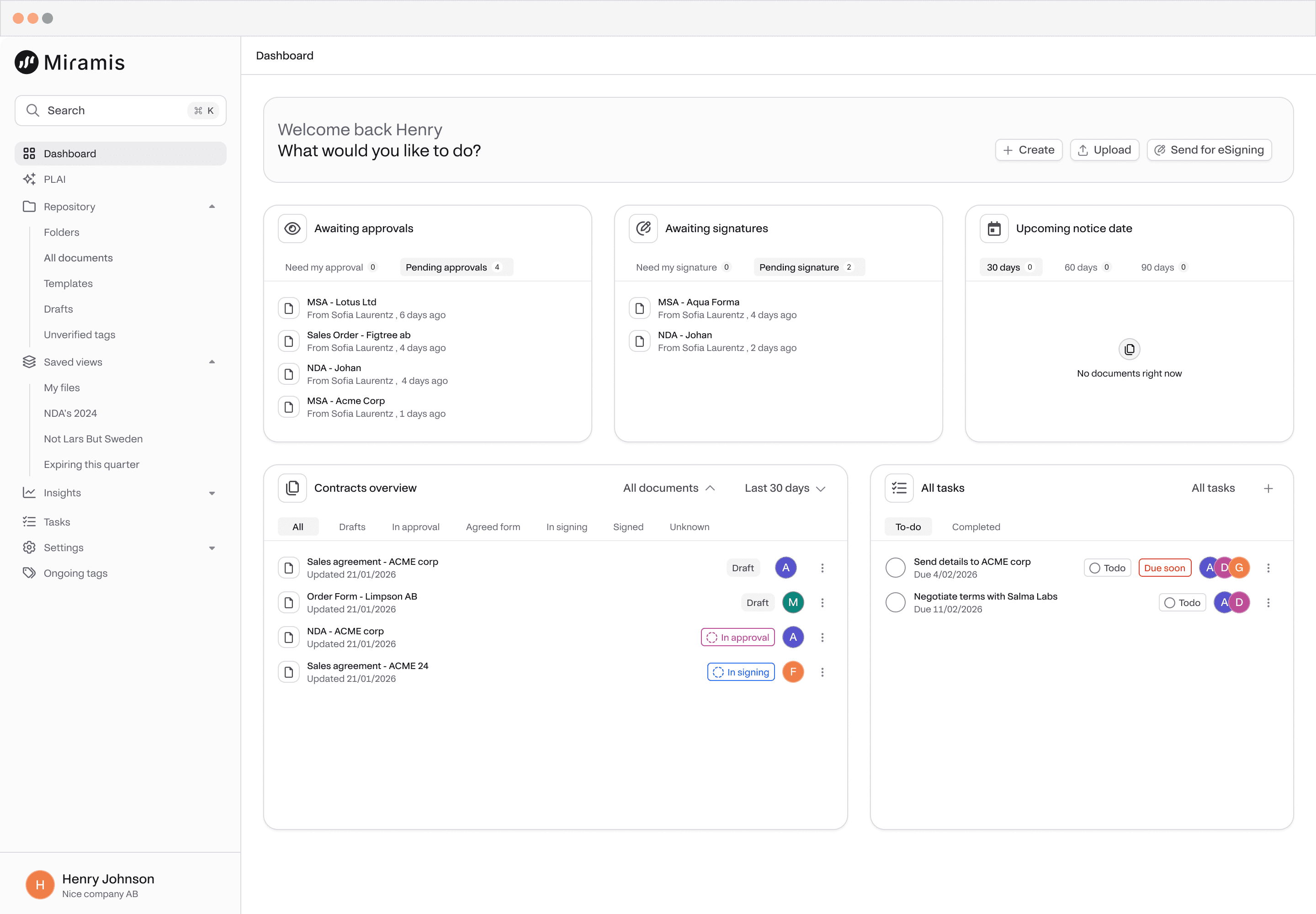
Contract approval software
Contract approval software
Approval guardrails that never slow the business down
Approval guardrails that never slow the business down
Approval guardrails that never slow the business down
Compliance without the bottlenecks - no rigid rule builders, no chasing sign-offs across email, Teams or Slack. Miramis pairs your controls with AI judgment: set the rules once, and AI routes each contract to the right approver(s). Everything else goes straight through - no missed sign-offs, full audit trail on every decision.
Compliance without the bottlenecks - no rigid rule builders, no chasing sign-offs across email, Teams or Slack. Miramis pairs your controls with AI judgment: set the rules once, and AI routes each contract to the right approver(s). Everything else goes straight through - no missed sign-offs, full audit trail on every decision.
ISO 27001 · SOC 2 · GDPR · eIDAS-compliant eSigning
ISO 27001 · SOC 2 · GDPR · eIDAS-compliant eSigning
What is a contract approval workflow?
Contract approval workflows check whether a contract needs sign-off before it’s sent for signature, and routes the request automatically. Miramis is built to ask this question first, is approval needed at all, only when the answer is yes does it interrupt anyone.
Why most contract approval tools get switched off
Why most contract approval tools get switched off
Approval features are common in contract software. Used ones are rarer, and it usually comes down to trust, not functionality.
Approval features are common in contract software. Used ones are rarer, and it usually comes down to trust, not functionality.
| Most contract tools | Miramis | |
|---|---|---|
| Setup | Most contract toolsComplex, low-code rule builders configured by hand | MiramisNatural-language instructions. Drop in your playbook and approval policy |
| Flexibility | Most contract toolsReacts to events. Any edit fires a review, blind to substance | MiramisReads the substance. Knows what changed and whether it actually matters |
| Routing | Most contract toolsFires on static conditions, then sign-offs get chased across email, Teams, and Slack | MiramisRoutes only what needs a check. Everything else goes straight through |
| Approver context | Most contract toolsA link and a document, with no sense of what changed | MiramisThe approver sees what triggered the check and what changed |
| Trust over time | Most contract toolsAfter the third pointless request, people route around it | MiramisRequests stay relevant, so the tool stays on |
| Audit | Most contract toolsPartial trail, stitched together after the fact | MiramisFull audit trail on every decision |
Miramis is built against both failure modes. Fewer requests, and enough context in each one to decide immediately.
Miramis is built against both failure modes. Fewer requests, and enough context in each one to decide immediately.
How contract approvals work in Miramis
01
Check and decide
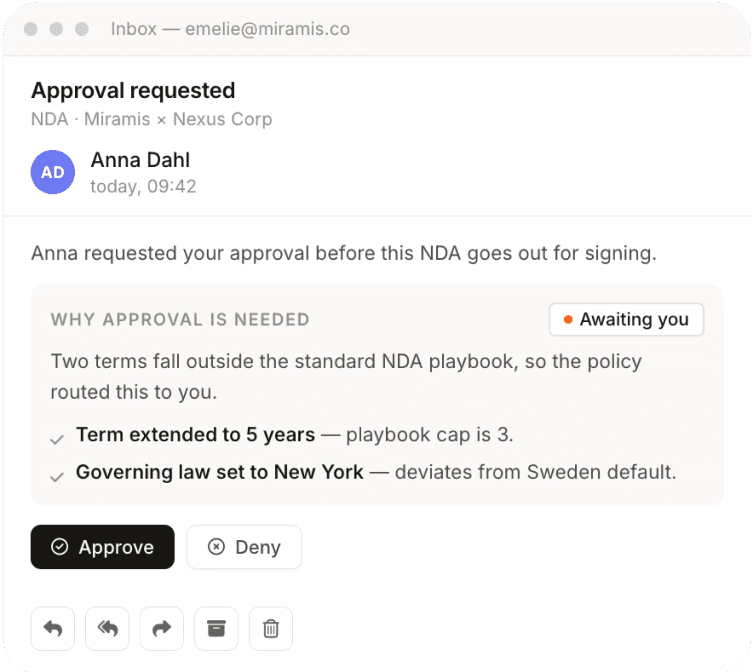
Miramis checks the document against your rules, then PLAI assesses it and returns a verdict, reasoning, and the right approver.


02
Sent with context
The request carries a message drafted from the assessment. The approver sees why, not just what.


03
Decide by email
The approver acts straight from their inbox. Approve or reject, no login required.

01
Check and decide
Miramis checks the document against your rules, then PLAI assesses it and returns a verdict, reasoning, and the right approver.
02
Sent with context
The request carries a message drafted from the assessment. The approver sees why, not just what.
03
Decide by email
The approver acts straight from their inbox. Approve or reject, no login required.
01
Check and decide
Miramis checks the document against your rules, then PLAI assesses it and returns a verdict, reasoning, and the right approver.
02
Sent with context
The request carries a message drafted from the assessment. The approver sees why, not just what.
03
Decide by email
The approver acts straight from their inbox. Approve or reject, no login required.
Approval rules built for how your business actually decides
Not every contract needs the same sign-off. Miramis supports the patterns organisations actually use.
01
Single approver
One named person must approve. No backup, no group.
02
Primary + backup
If the primary approver doesn’t act, it escalates automatically.
03
Any one of a group
Sent to everyone in the group. First to approve resolves it.
04
Two named approvers
Two specific people must both approve, not chosen from a group.
05
Any two of a group
Any two people from the group must approve, not fixed individuals.
06
All approvers
Every listed approver must approve, in parallel or in sequence.
Audit trail
Every decision, recorded automatically

Every assessment, request, approval, and rejection logged with a timestamp
Full reasoning behind every AI verdict, kept alongside the decision
Re-run assessments are logged too, so you can see which version was used
Nothing to configure. Legal gets a complete record without reviewing every contract

Guardrails every team can actually rely on

Legal
Encode the policy once. Standard contracts stop reaching your desk, the ones that do arrive with the reasoning already done.

Sales
Standard contracts go straight to signing. Deals that need sign-off get routed the moment they're ready.

Finance
Approval thresholds applied consistently, not remembered case by case, with a record of every decision.

HR
Offer letters and employment contracts follow the same rules every time, whoever is hiring.
HR
Offer letters and employment contracts follow the same rules every time, whoever is hiring.
Finance
Approval thresholds applied consistently, not remembered case by case, with a record of every decision.
Finance
Approval thresholds applied consistently, not remembered case by case, with a record of every decision.
HR
Offer letters and employment contracts follow the same rules every time, whoever is hiring.

Procurement
Supplier contracts route to the right approver automatically, based on value and risk.
SSO/SAML
·
Role-based permissions
ISO 27001
·
·
SOC 2
·
GDPR-native
·
eIDAS-compliant eSigning
Frequently Asked Questions
What is contract approval software?
Contract approval software checks whether a contract needs sign-off before it moves to signature, and routes the request to the right person automatically. Instead of every contract passing through a legal queue by default, the system evaluates each document against rules an organisation has defined, and only interrupts someone when approval is genuinely needed. Miramis is built around this distinction: fewer unnecessary requests, and full context in the ones that do go out.
How does Miramis decide when a contract needs approval?
Miramis checks a document against structured conditions your organisation defines, such as which template it came from, who created it, and whether any free-text edits were made. If nothing matches, the contract proceeds straight to signature with no approval prompt. If a condition is met, PLAI, our AI contract agent, assesses the document against your rules and returns a verdict, the reasoning behind it, and the approvers required, before any request is sent.
Can approvers act without logging into the platform?
Yes. Every approval request is sent by email with everything the approver needs to decide: the document, the reasoning behind the request, what changed from the original template, and who else needs to sign off. Approve or reject directly from the email, with no login required unless more context is genuinely needed.
What approval structures does Miramis support?
Miramis supports the approval patterns organisations actually use: a single named approver, a primary approver with an automatic backup, any one person from a defined group, two specific named approvers, any two people from a group, or every listed approver acting in parallel or in a defined sequence. Sequential approval is built for hierarchy, so each approver is notified only once the person before them has acted.
What’s the difference between contract approval software and contract workflow software?
Contract approval software focuses specifically on the sign-off step: deciding when approval is needed, who should give it, and how quickly a decision can be reached. Contract workflow software covers the full contract journey, including drafting, negotiation, and signing, with approval as one stage within it. Miramis provides both, in one platform.
Is contract approval software the same as eSigning?
No. eSigning is the final step where a contract is signed. Approval happens before that, deciding whether a contract needs review, and by whom, before it’s ever sent to be signed. Miramis handles both natively: automated approval routing based on your Delegation of Authority, followed by native eIDAS-compliant eSigning, with a complete audit trail across the whole process.
Frequently Asked Questions
What is contract approval software?
Contract approval software checks whether a contract needs sign-off before it moves to signature, and routes the request to the right person automatically. Instead of every contract passing through a legal queue by default, the system evaluates each document against rules an organisation has defined, and only interrupts someone when approval is genuinely needed. Miramis is built around this distinction: fewer unnecessary requests, and full context in the ones that do go out.
How does Miramis decide when a contract needs approval?
Miramis checks a document against structured conditions your organisation defines, such as which template it came from, who created it, and whether any free-text edits were made. If nothing matches, the contract proceeds straight to signature with no approval prompt. If a condition is met, PLAI, our AI contract agent, assesses the document against your rules and returns a verdict, the reasoning behind it, and the approvers required, before any request is sent.
Can approvers act without logging into the platform?
Yes. Every approval request is sent by email with everything the approver needs to decide: the document, the reasoning behind the request, what changed from the original template, and who else needs to sign off. Approve or reject directly from the email, with no login required unless more context is genuinely needed.
What approval structures does Miramis support?
Miramis supports the approval patterns organisations actually use: a single named approver, a primary approver with an automatic backup, any one person from a defined group, two specific named approvers, any two people from a group, or every listed approver acting in parallel or in a defined sequence. Sequential approval is built for hierarchy, so each approver is notified only once the person before them has acted.
What’s the difference between contract approval software and contract workflow software?
Contract approval software focuses specifically on the sign-off step: deciding when approval is needed, who should give it, and how quickly a decision can be reached. Contract workflow software covers the full contract journey, including drafting, negotiation, and signing, with approval as one stage within it. Miramis provides both, in one platform.
Is contract approval software the same as eSigning?
No. eSigning is the final step where a contract is signed. Approval happens before that, deciding whether a contract needs review, and by whom, before it’s ever sent to be signed. Miramis handles both natively: automated approval routing based on your Delegation of Authority, followed by native eIDAS-compliant eSigning, with a complete audit trail across the whole process.
Frequently Asked Questions
What is contract approval software?
Contract approval software checks whether a contract needs sign-off before it moves to signature, and routes the request to the right person automatically. Instead of every contract passing through a legal queue by default, the system evaluates each document against rules an organisation has defined, and only interrupts someone when approval is genuinely needed. Miramis is built around this distinction: fewer unnecessary requests, and full context in the ones that do go out.
How does Miramis decide when a contract needs approval?
Miramis checks a document against structured conditions your organisation defines, such as which template it came from, who created it, and whether any free-text edits were made. If nothing matches, the contract proceeds straight to signature with no approval prompt. If a condition is met, PLAI, our AI contract agent, assesses the document against your rules and returns a verdict, the reasoning behind it, and the approvers required, before any request is sent.
Can approvers act without logging into the platform?
Yes. Every approval request is sent by email with everything the approver needs to decide: the document, the reasoning behind the request, what changed from the original template, and who else needs to sign off. Approve or reject directly from the email, with no login required unless more context is genuinely needed.
What approval structures does Miramis support?
Miramis supports the approval patterns organisations actually use: a single named approver, a primary approver with an automatic backup, any one person from a defined group, two specific named approvers, any two people from a group, or every listed approver acting in parallel or in a defined sequence. Sequential approval is built for hierarchy, so each approver is notified only once the person before them has acted.
What’s the difference between contract approval software and contract workflow software?
Contract approval software focuses specifically on the sign-off step: deciding when approval is needed, who should give it, and how quickly a decision can be reached. Contract workflow software covers the full contract journey, including drafting, negotiation, and signing, with approval as one stage within it. Miramis provides both, in one platform.
Is contract approval software the same as eSigning?
No. eSigning is the final step where a contract is signed. Approval happens before that, deciding whether a contract needs review, and by whom, before it’s ever sent to be signed. Miramis handles both natively: automated approval routing based on your Delegation of Authority, followed by native eIDAS-compliant eSigning, with a complete audit trail across the whole process.

From first draft to full intelligence
From first draft to full intelligence
From first draft to full intelligence
A 30-minute walkthrough, tailored to how your team works.
A 30-minute walkthrough, tailored to how your team works.
ISO 27001 · SOC 2 · GDPR
ISO 27001 · SOC 2 · GDPR