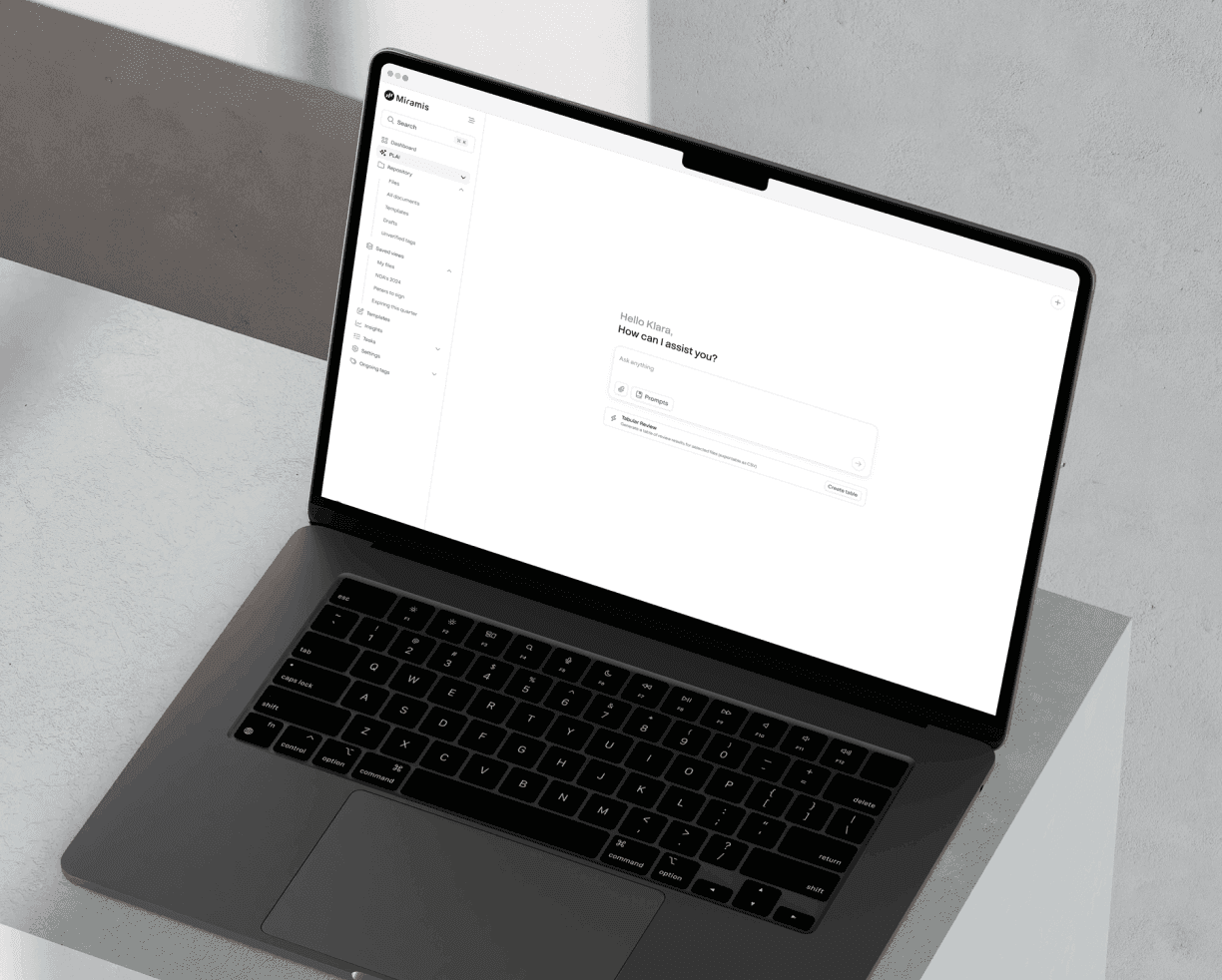







Both Miramis and Contractbook position themselves as full contract lifecycle platforms. The differences sit in scale, AI depth, editor and Word integration, and what comes included versus what costs extra.
Feature
Miramis
contractbook
Core Functionality
Full contract lifecycle
✓
✓
Browser-based editor
✓
✓
Microsoft Word add-in
✓
✗
Pre-approved templates
✓
✓
Self-serve template setup
✓
Limited
Editor formatting depth
✓
Limited
Conditional logic in templates
✓
✓
AI Capabilities
AI contract review against playbook
✓
✗
AI metadata extraction
✓
✓
✓
✗
✓
✗
✓
✗
Natural language Q&A across contracts
✓
✗
AI-generated reports and dashboards
✓
Limited
Workflow & Collaboration
✓
✓
✓
Limited
External negotiation workspace
✓
Limited
Internal commenting and redlining
✓
Limited
✓
✓
eSigning
Native eSigning included
✓
✓
eIDAS-compliant
✓
✓
BankID / MitID support
✓
✓
DocuSign integration
✓
✓
Repository & Post-Sign
Intelligent contract repository
✓
✓
Obligation and renewal tracking
✓
✓
✓
Limited
Custom filtered views (saveable)
✓
✓
Plain-language portfolio queries
✓
✗
Integrations
Salesforce
Included
Paid add-on
HubSpot
Included
Included
SharePoint
Included
Limited
API/WebAPI access
Included
Paid add-on
Zapier integration
Included
Paid add-on
Pricing & scale
Contract volume limits
None
User seat limits
Flexible
Template limits
Flexible
Security & Compliance
ISO 27001
✓
Limited
SOC 2
✓
✓
European data residency
✓
✓
SSO / SAML
✓
Limited
Advanced role-based permissions
✓
Limited
Implementation & Support
AI-powered implementation
✓
✗
Dedicated customer success
✓
✓
What users report
Miramis approach
Pricing model that punishes growth
Contractbook
Miramis
Editor and Word integration limitations
Contractbook
Miramis
Built for sending, not for managing complexity
Contractbook
Miramis
No Contract Caps, No Integration Paywalls
The most significant difference between Miramis and Contractbook shows up in what you can actually do with the platform. Contractbook's highest tier caps at 500 completed contracts per year. Standard plans limit users to 10 maximum. API access, Salesforce integration, and Zapier are all paid add-ons charged separately. For organisations that grow beyond an initial use case, the cost compounds quickly and the contract limits become a hard ceiling.
Miramis is built differently. No contract volume caps. No per-user restrictions that force expensive tier upgrades. Integrations to Salesforce, HubSpot, API access, and the broader integration ecosystem are included as standard. Pricing scales with your organisation's actual usage, not with arbitrary limits designed to push the next plan upgrade.
A Contract Agent, Not Basic Extraction
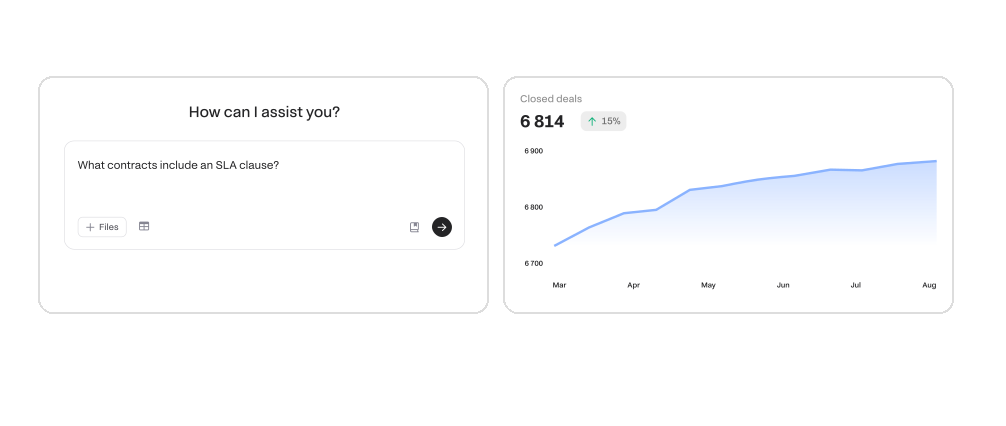
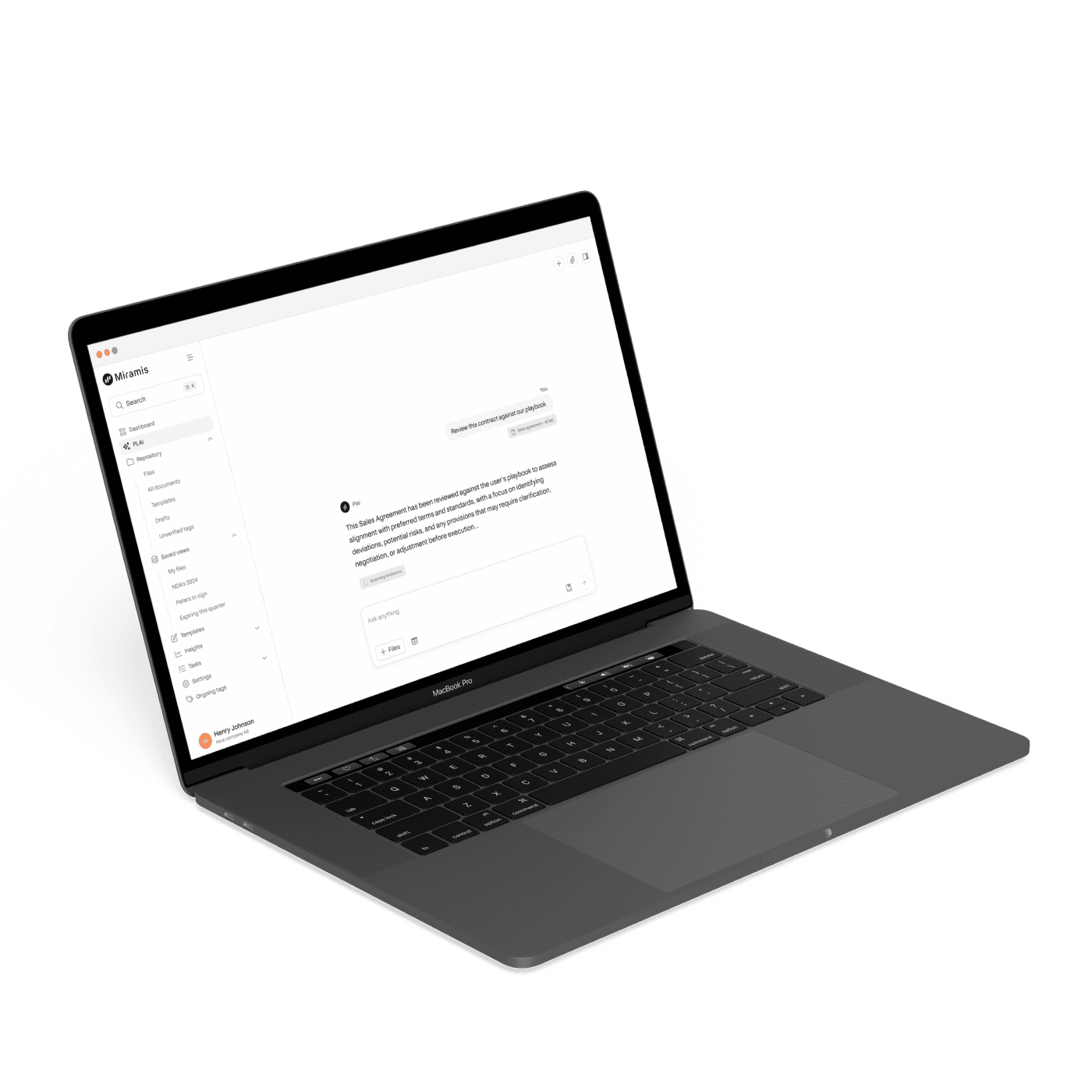
Contractbook includes AI for data extraction, contract summarisation, and reminder suggestions - useful capabilities for a repository-focused workflow. Miramis is built around PLAI, an AI contract agent trained on your company's contract data, playbooks, and standards.
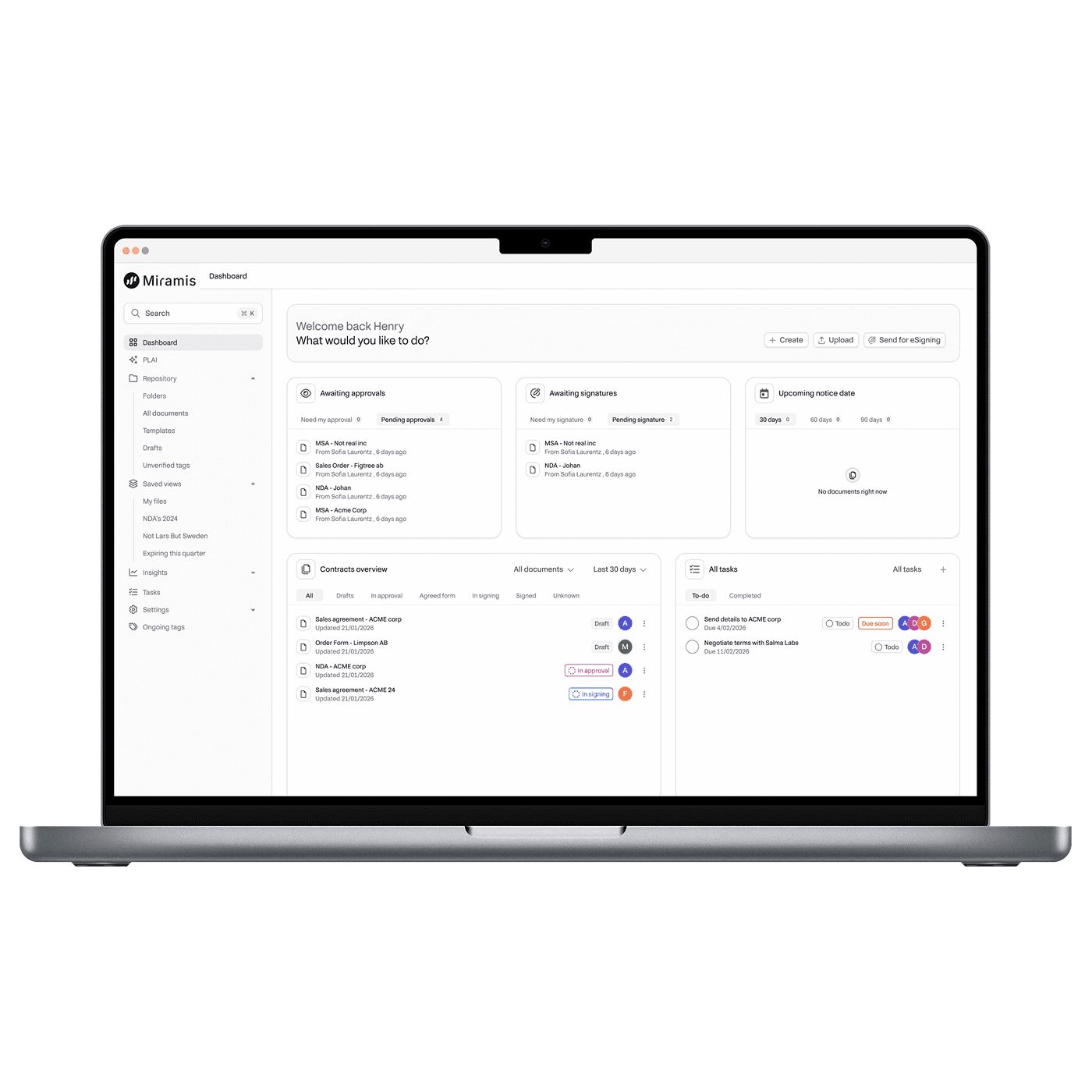
PLAI reviews every contract against your playbook, telling business teams what they can approve, suggesting alternative wordings for flagged clauses, and identifying what needs escalation. It routes approvals automatically based on your Delegation of Authority - no manual chasing. It analyses thousands of agreements simultaneously with tabular output, compares clauses across portfolios, and surfaces risks across the entire archive. And it answers natural language questions about your contract portfolio in plain language - obligations, renewals, risk exposure - in seconds.
This is not AI as a feature within a CLM. This is AI as the engine that powers every workflow.
Meet Legal Teams Where They Already Work
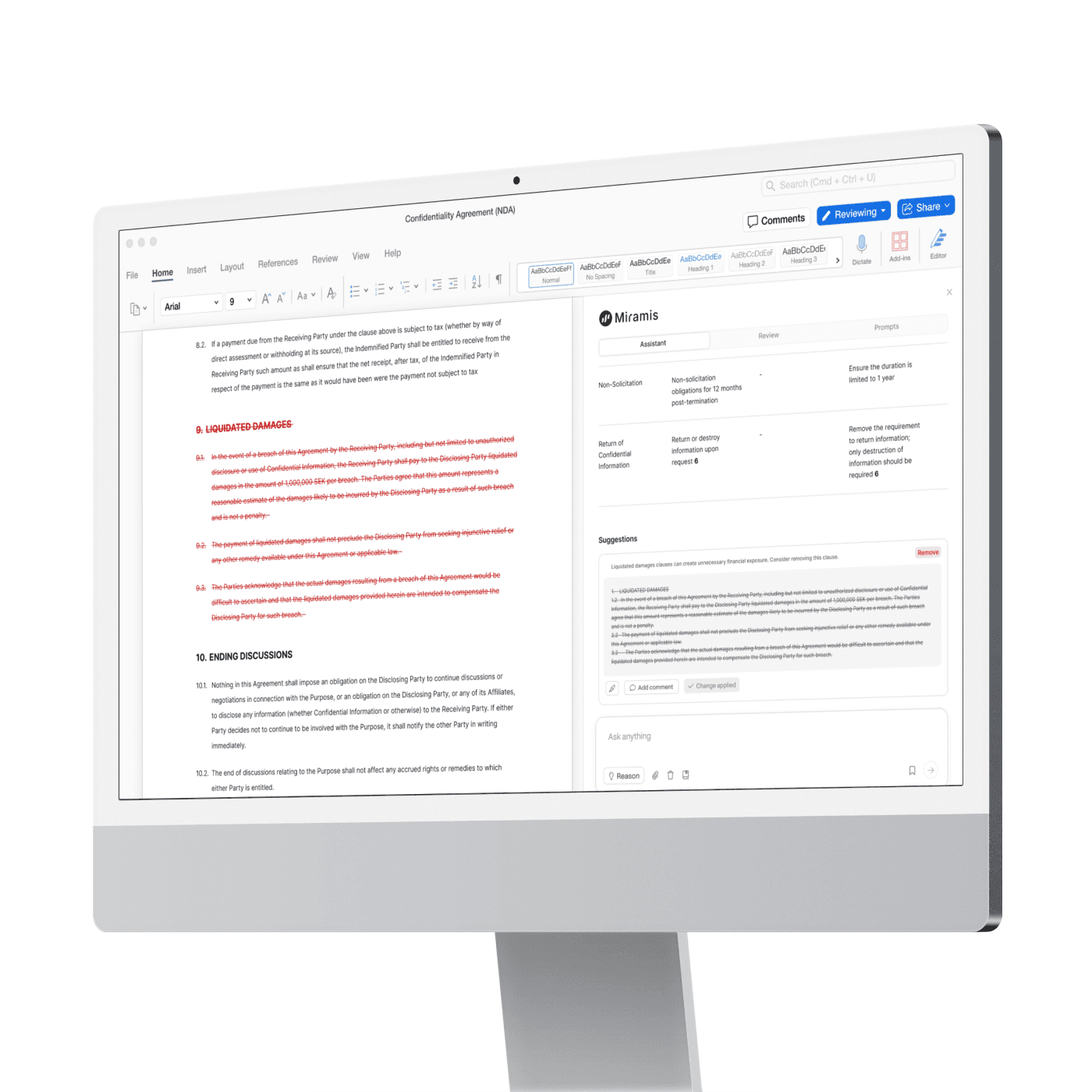
Most legal teams draft and negotiate in Microsoft Word. It's the standard. Contractbook does not support Word import or export, which means every counterparty redline and every internal revision has to happen in Contractbook's browser editor - or the workflow breaks.
Miramis includes a native Microsoft Word add-in. Legal teams draft, redline, and review contracts directly in Word with PLAI's review capabilities and the company's clause library accessible from a sidebar. Everything stays synced with the platform. When counterparties want to negotiate in Word, contracts export cleanly and re-import as a new version. No friction, no broken workflows, no tool switching.
Every Contract, Queryable in Plain Language
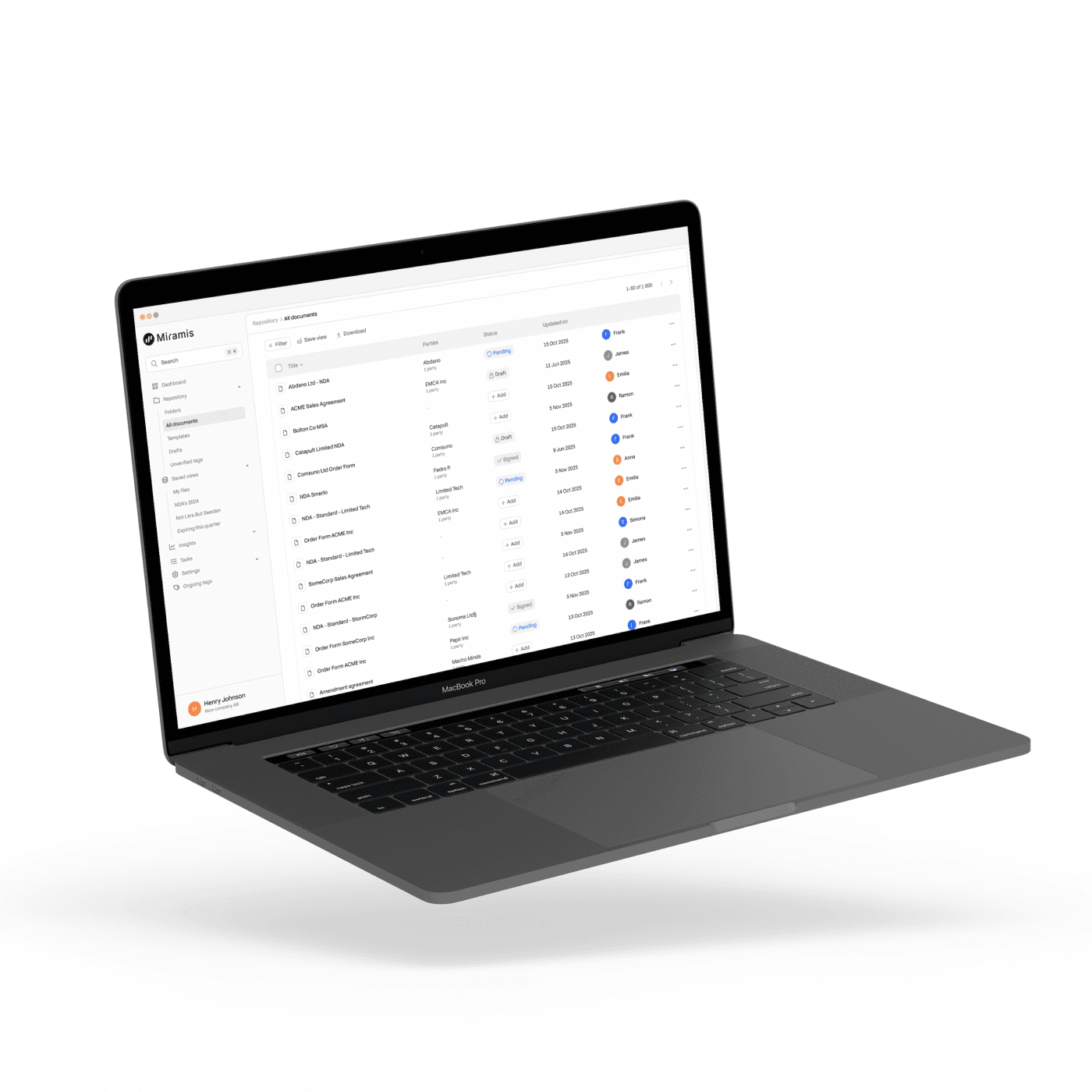
Both Miramis and Contractbook have contract repositories with metadata, search, and renewal tracking. The difference is what happens when you need answers from your archive. In Contractbook, you search by metadata, filter, and navigate folders. In Miramis, you ask a question.
PLAI turns the entire repository into interactive intelligence. "Which contracts auto-renew before December?" "Which agreements have a non-standard limitation of liability clause?" "What's our total exposure to MFN clauses?" Answer in seconds. Save custom filtered views like "Auto-renewals expiring before December 2027" for one-click access. Track every obligation, renewal, and termination window with automated reminders.
For legacy contracts, the difference is even more significant. Bulk-upload thousands of historical agreements and PLAI automatically extracts metadata, tags every document, and makes the entire archive fully searchable - in minutes, not months.























Enterprise-Ready from Day One
Built for enterprise security review. Your data is never used to train AI models.
ISO 27001
SOC 2
GDPR-native
eIDAS-compliant
SSO / SAML
European data residency