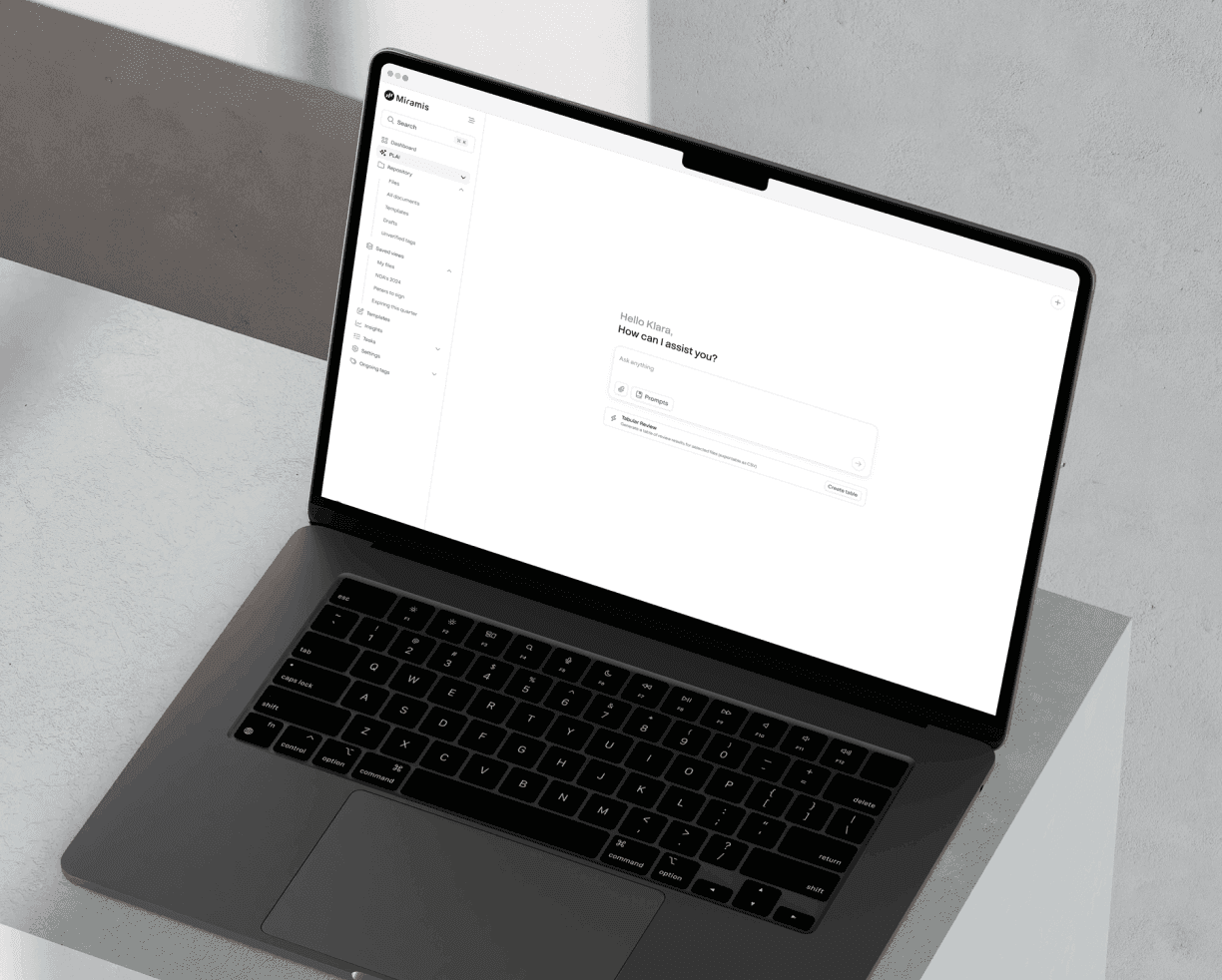







When comparing two contract lifecycle management (CLM) software solutions, the most important criteria to evaluate include core functionality, AI capabilities, contract repository depth, end-to-end lifecycle coverage, workflow customisation, eSignature, security, and total cost of ownership. The comparison below covers each across both platforms.
Feature
Miramis
icertis
Core Functionality
Full contract lifecycle
✓
✓
Contract creation
✓
✓
Self-serve template setup
✓
Limited
Pre-approved templates
✓
✓
Conditional logic in templates
✓
✓
AI Capabilities
AI Contract Agent
PLAI
ICI Copilot
AI metadata extraction
✓
✓
✓
✓
Natural language Q&A across contracts
✓
✓
Native AI Architecture
✓
Limited
Workflow & Collaboration
✓
✓
✓
✓
Workflow configuration without IT
✓
Limited
Multi-stage approvals
✓
✓
negotiation tools
Internal commenting and redlining
✓
✓
Version comparison
✓
✓
External counterparty negotiation
✓
✓
eSigning
Native eSigning included
✓
✗
eIDAS-compliant
Native
Via integration
BankID / MitID support
Native
Via third-party
DocuSign integration
✓
✓
Collaboration features
Microsoft Word add-in
✓
✓
Microsoft Teams integration
✓
✓
Outlook integration
✓
✓
Real-time collaboration
✓
✓
Contract Performance metrics
Risk scoring
✓
✓
Custom KPI tracking
✓
✓
Portfolio analytics
✓
✓
Integrations
Salesforce
✓
✓
HubSpot
✓
Limited
Microsoft 365
✓
✓
SAP S/4HANA, Ariba, Fieldglass
Limited
✓
Security & Compliance
ISO 27001
✓
✓
SOC 2
✓
✓
GDPR-native architecture
✓
✓
European data residency
✓
✓
SSO / SAML
✓
✓
Support & training
✓
✓
Dedicated customer success
Yes
Yes (tiered)
Cost & value
✓
✓
Mid-market accessibility
Yes
✗
Implementation Cost
Lower
Higher
user experience
✓
Limited
✓
Limited
✓
Limited
Do you require a custom plan?
Where Icertis Users Run Into Limitations
Icertis is a recognised CLM leader with proven capability at the top of the enterprise market - managing 10M+ contracts for 33% of the Fortune 100. The friction users describe in independent reviews focuses on areas where Icertis's enterprise-first design creates trade-offs for organisations outside Fortune 500 scale. These are recurring themes across G2, Gartner Peer Insights, and Capterra.
What users report
Miramis approach
Dated user interface and adoption friction
Icertis
"The user interface is possibly one of the worst modern SaaS applications I've seen" and "The CLM market has evolved since 2019. Icertis has not" appear in verified G2 reviews. Other users cite "too many clicks to reach the desired function" and that "the system is not intuitive and users require a lot of support." 70% of Icertis G2 reviews come from enterprise organisations with 1,000+ employees - the platform's complexity creates a steep adoption curve outside that segment.
Miramis
Built with adoption as the primary design principle. Reviewers consistently describe the interface as intuitive enough for Sales, HR, and Procurement teams to self-serve without legal involvement on every contract. Modern, clean SaaS UX that mid-market teams adopt without extensive change management investment.
6-12 month implementation timelines
Icertis
"Very lengthy implementation and onboarding process" cited in G2 reviews, with typical timelines running 6-12 months for enterprise deployments. Customisation difficulties cited consistently: "the customisations were a pain to maintain during the upgrade process" and "too many dependencies on back end team for configuration." Hyperstart's analysis notes first-year total costs of $100,000-$300,000 when implementation, licensing, and training are combined.
Miramis
AI-powered onboarding migrates legacy contracts in bulk with automatic metadata extraction, configures playbooks, and gets teams live in weeks rather than months. Self-serve configuration means most workflow adjustments happen without backend developer support. Lower total cost of ownership across the first year.
34% above market average pricing
Icertis
G2 pricing data indicates Icertis runs approximately 34% above the CLM market average. Custom enterprise quotes only; no public pricing tiers. Reviewers consistently note the pricing model is "out of budget for most mid-market or scaling companies" - the platform is best suited to organisations in the Fortune 500 segment that can absorb enterprise CLM pricing.
Miramis
Transparent custom pricing based on usage and team size, accessible to mid-market organisations as well as enterprise. Native eSigning included rather than requiring a separate DocuSign subscription, which removes one of the standard adjacent CLM costs.
34% above market average pricing
Icertis
"Powerful insights but reports are not easy to build" - Icertis is noted for analytics depth but reviewers consistently flag that creating custom dashboards and reports requires technical expertise. Out-of-the-box reports are limited; significant configuration is typically required.
Miramis
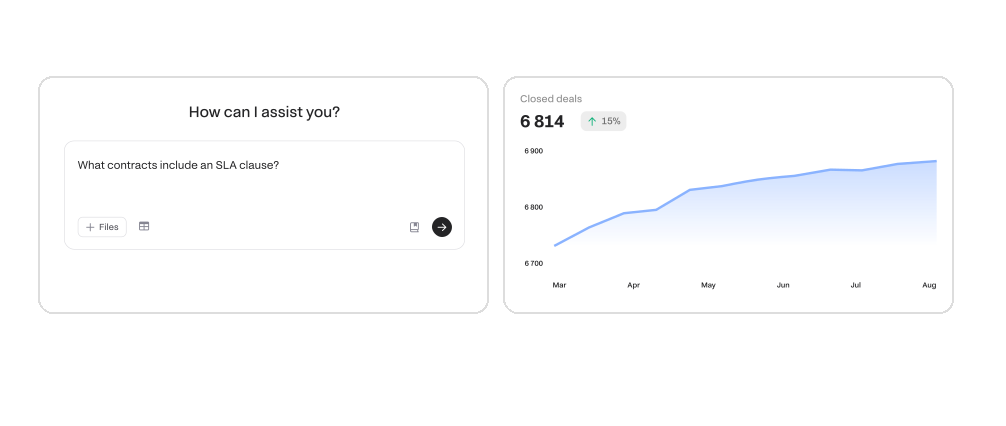
PLAI lets you ask natural language questions across the full contract portfolio and generate reports automatically. "Which contracts auto-renew before December?" or "What's our total exposure to MFN clauses?" - get the answer in seconds without building a custom dashboard. Saved filtered views, CSV export, and automated obligation reporting are built in.
Based on verified user reviews from G2, Gartner Peer Insights, and Capterra.
Five capabilities make Miramis a powerful Icertis alternative for organisations evaluating enterprise CLM platforms: native AI architecture, the PLAI AI contract agent, integration fit, repository visibility, and a user experience designed for adoption. Each addresses a documented friction point for Icertis users.
Native AI That Works Out of the Box
Miramis is built AI-native - PLAI is the architectural foundation of the platform, not a feature added on top of an older CLM design. AI capabilities are embedded across drafting, review, approval routing, obligation tracking, and portfolio analysis from the first day a customer goes live. There's no separate AI configuration phase, no AI features locked behind premium tiers, and no requirement to integrate with external AI tools to get analytical depth.
Icertis has invested significantly in AI capabilities including Icertis Contract Intelligence Copilot (IICP) and continues to add AI features to the ICI platform. Both platforms perform well on AI-assisted clause extraction and portfolio analysis. The architectural difference is in how the AI was designed in: Miramis's PLAI was the starting architecture, while Icertis has been retrofitting AI capabilities onto a CLM platform originally designed in 2009. For organisations that want AI as the primary operating layer of the platform rather than as a capability layer added on top, Miramis's architecture is the closer fit.
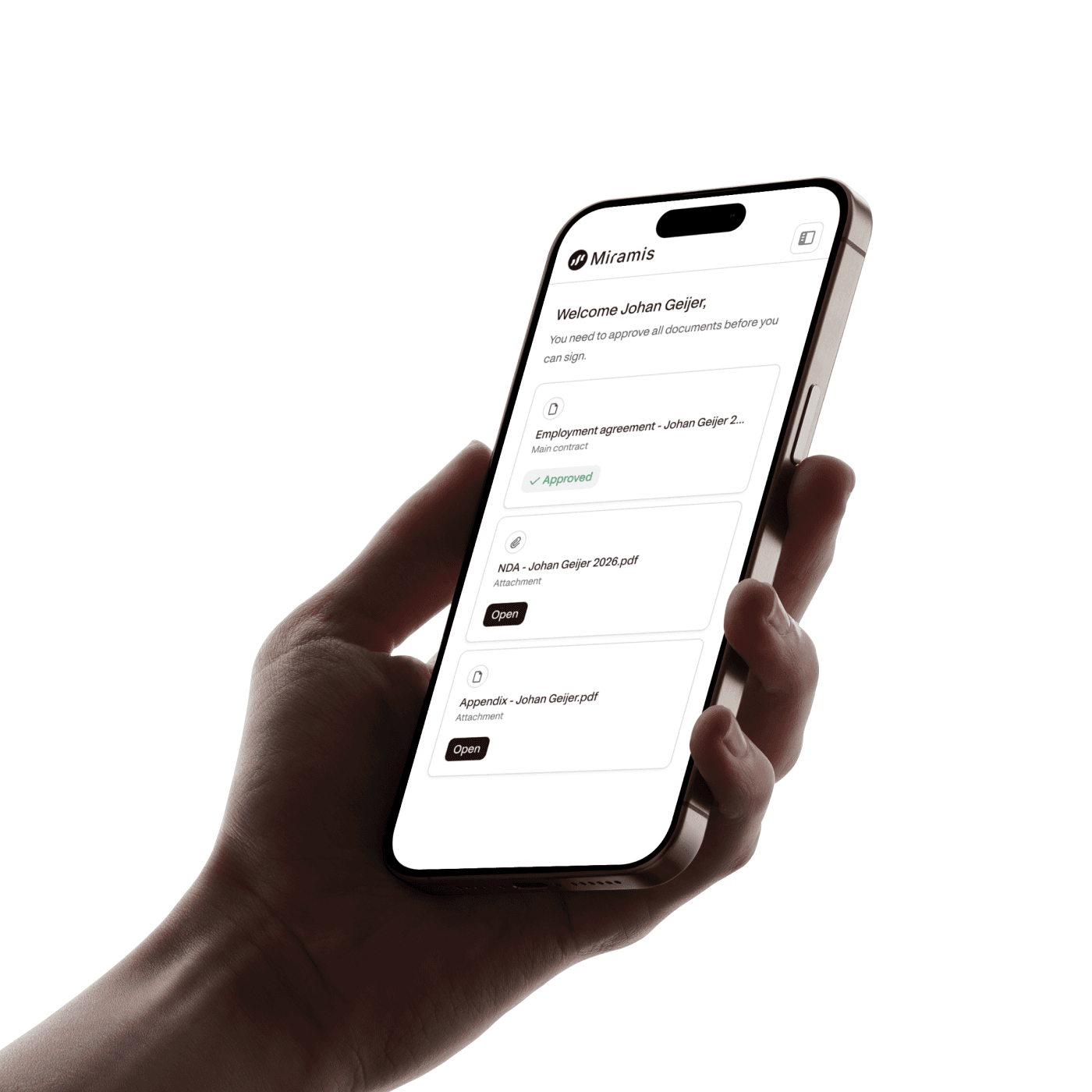
AI Contract Agent
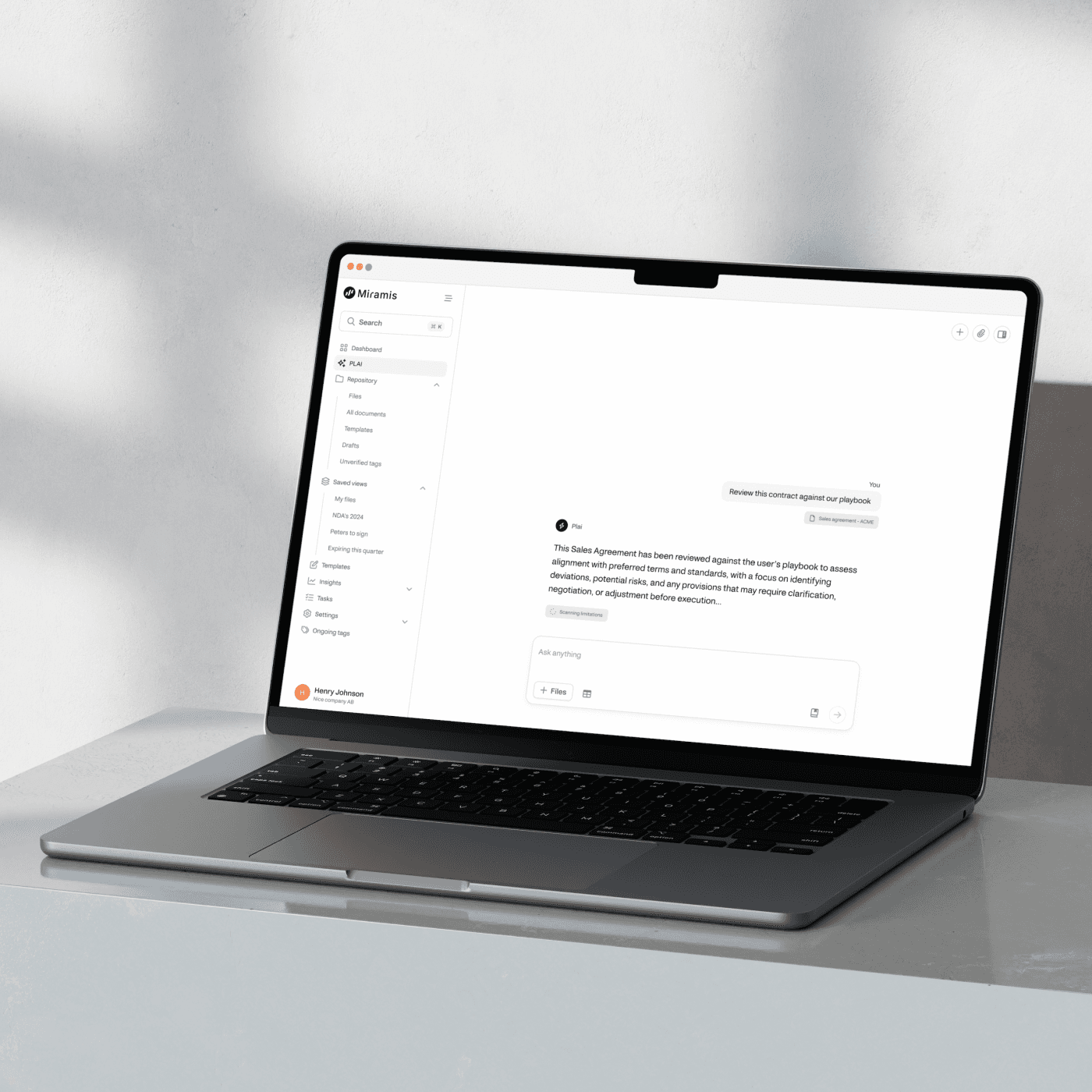
PLAI is Miramis's AI contract agent - powered by each company's own contracts, playbooks, and guardrails. It drafts contracts from pre-approved templates, assists with redlining against your playbook, routes approvals automatically based on Delegation of Authority, surfaces obligations and renewal risks across the full archive, and answers natural language questions about your portfolio in plain English. The architectural distinction matters: PLAI integrates into every step of the contract lifecycle, while Icertis's AI features (IICP, AI clause extraction, AI playbook review) sit alongside the workflow as separate capabilities to invoke.
For day-to-day legal operations, this means different patterns of work. With Icertis, AI is a tool legal teams use at specific moments - when reviewing a particularly complex contract, generating an executive summary of a long agreement, or running portfolio analytics. With Miramis, PLAI is operating continuously across every contract, every approval, and every workflow - so the AI value isn't dependent on someone remembering to use it. Both approaches deliver AI capability; the difference is how the AI shows up in daily operations.
Integrations That Fit How Teams Already Work
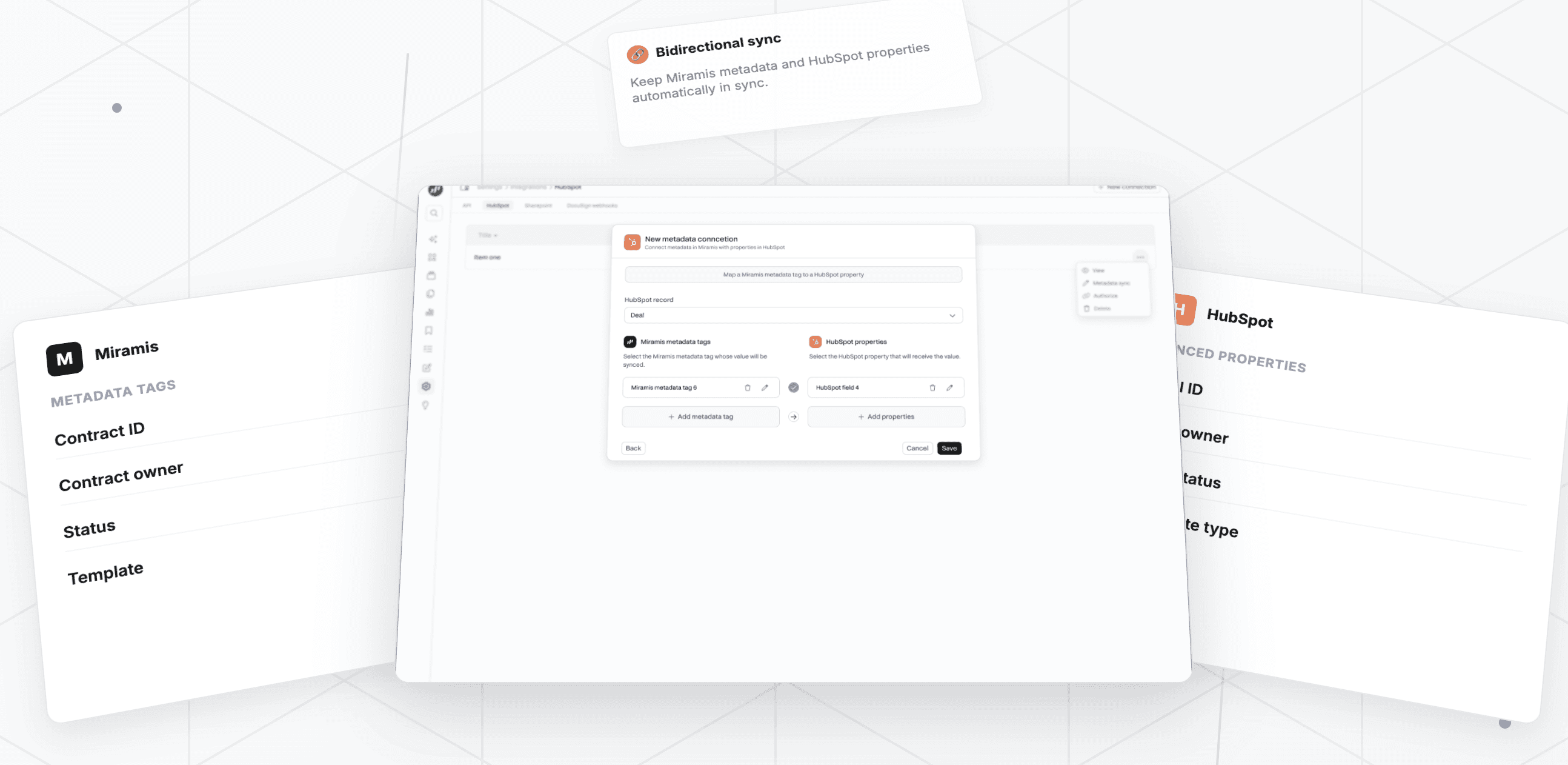
Miramis offers native integrations with the systems mid-market and enterprise teams actually use: Salesforce, HubSpot, Microsoft 365 (Word, Outlook, Teams), DocuSign, SharePoint, and a REST API for everything else. The Microsoft Word add-in lets legal teams draft, review, and redline contracts directly inside Word with full access to playbooks and templates. Sales teams generate contracts inside Salesforce or HubSpot without leaving their CRM. Approvals route through Outlook and Teams.
Icertis offers similar core integrations - Salesforce, Microsoft 365, Outlook add-in, Teams integration - with a particularly deep SAP partnership covering S/4HANA, Ariba, and Fieldglass. For organisations standardised on SAP for ERP and procurement, Icertis's SAP integration depth is genuinely strong and a legitimate reason to choose the platform. Both platforms perform well on Salesforce and Microsoft 365 integration. The difference shows up at the configuration layer: reviewers consistently note that Icertis integrations and customisations require backend team support to maintain, while Miramis integrations are designed for self-serve configuration where possible.
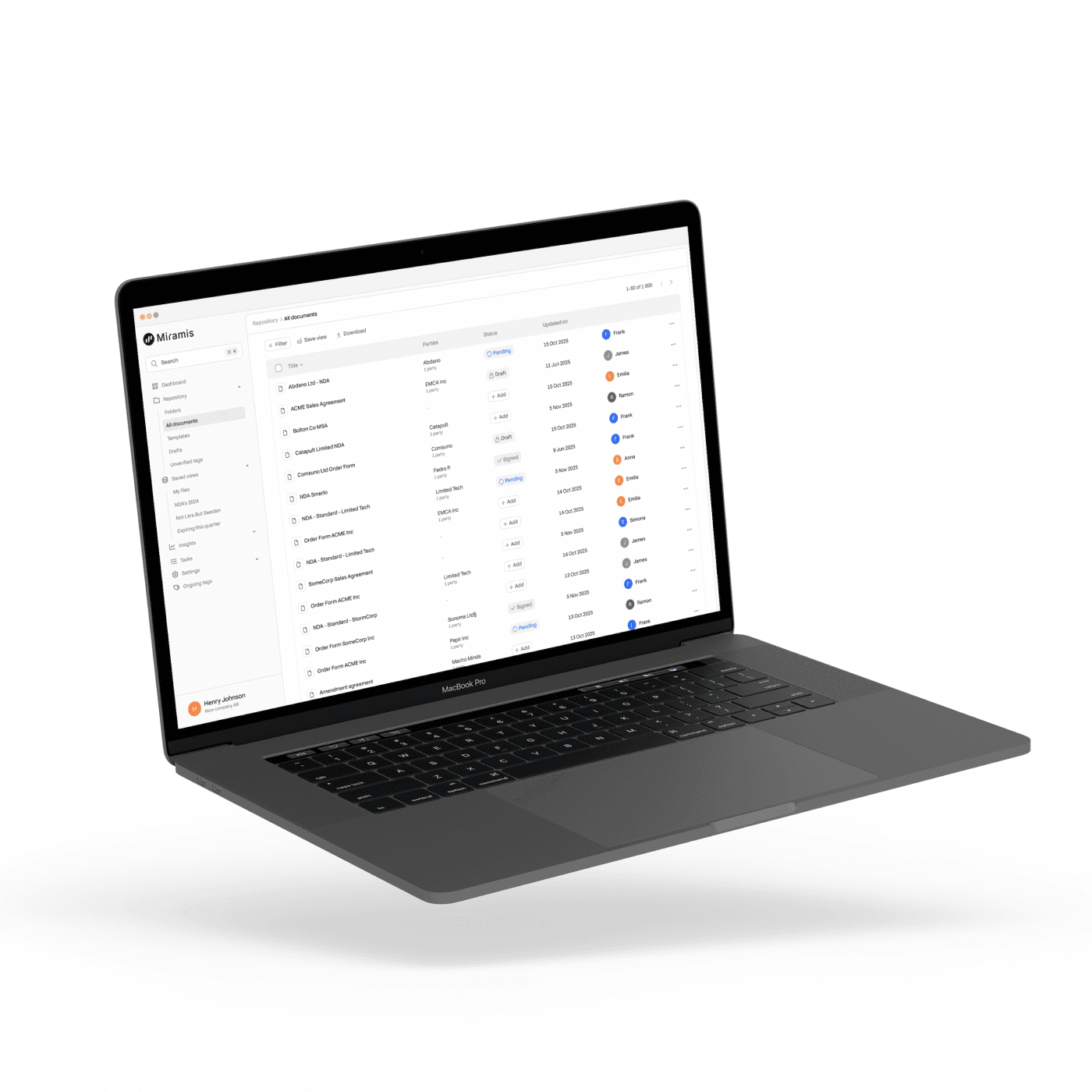
A Repository Built for Visibility and Control
Miramis's intelligent repository is built around natural language search and AI-extracted metadata. Every contract - native, uploaded, or bulk-imported legacy PDF - is automatically tagged with extracted metadata and made fully queryable. PLAI lets you ask portfolio questions in plain English: "Which contracts auto-renew before December?" "What's our total exposure to MFN clauses?" "Which agreements have non-standard limitation of liability?" Custom filtered views are saveable, exportable to CSV, and automatically updated as new contracts are added.
Icertis offers a comprehensive contract repository with deep configurability, supporting millions of contracts across 40+ languages and 90+ countries. Both platforms perform well on core repository capabilities - centralised storage, metadata extraction, obligation tracking, and renewal alerts. The user-facing difference is reporting and analytics: G2 reviewers consistently note that Icertis's reports "are not easy to build" and that "out-of-the-box reports" are limited. For organisations that need a repository they can interrogate directly rather than one requiring custom dashboard development, Miramis's natural language query approach is the closer fit.
Designed for the People Who Use It
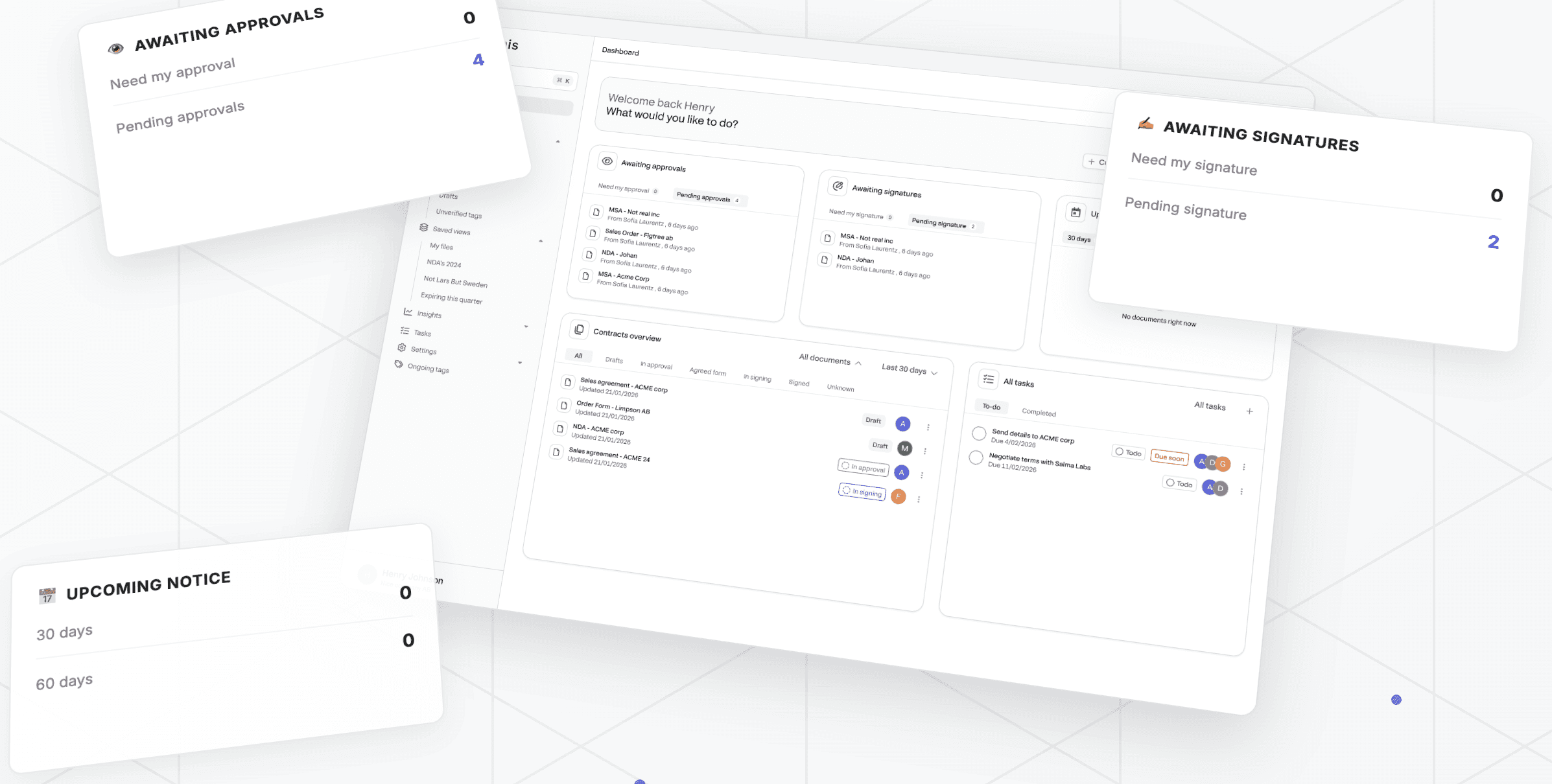
The biggest difference between Miramis and Icertis is in everyday user experience. Icertis's interface is consistently described in verified G2 reviews as "dated," "one of the worst modern SaaS applications," requiring "too many clicks to reach desired function." 70% of Icertis G2 reviewers work at organisations with 1,000+ employees - the platform's complexity creates friction for teams smaller than that scale.
Miramis is built around adoption as the primary design constraint. The user experience is designed for Sales, HR, and Procurement teams to handle their own contracts within legal-defined guardrails, not just for legal operations specialists. Customers consistently describe the platform as easy to use - the most common feedback after going live is some version of "it's so easy to use." This isn't a small difference for organisations evaluating CLM: low platform adoption is the leading cause of CLM project failure (industry adoption rates sit below 20% for legacy enterprise CLMs). A platform optimised for adoption from the start avoids the change management overhead that comes with legacy enterprise UX.





















Enterprise-Ready from Day One
Built for enterprise security review. Your data is never used to train AI models.
ISO 27001
SOC 2
GDPR-native
eIDAS-compliant
SSO / SAML
European data residency