Top 9 Ironclad Competitors and Alternatives in 2026

Top 9 Ironclad Competitors and Alternatives in 2026

Top 9 Ironclad Competitors and Alternatives in 2026

Top 9 Ironclad Competitors and Alternatives in 2026

Ironclad's main competitors in the CLM space include Miramis, Conga, DocuSign CLM, Icertis, Agiloft, ContractPodAi (now Leah), Evisort (now part of Workday), Juro, and PandaDoc. Each platform serves a different combination of team size, geography, and primary use case. Ironclad is a robust enterprise CLM with recognised customers including L'Oréal, OpenAI, Cisco, and Dropbox - companies typically look for alternatives when implementation complexity (3-6 months), US-centric architecture, or legal-team-centric workflows create friction for the Sales, HR, and Procurement teams that need to self-serve.

Ironclad's main competitors in the CLM space include Miramis, Conga, DocuSign CLM, Icertis, Agiloft, ContractPodAi (now Leah), Evisort (now part of Workday), Juro, and PandaDoc. Each platform serves a different combination of team size, geography, and primary use case. Ironclad is a robust enterprise CLM with recognised customers including L'Oréal, OpenAI, Cisco, and Dropbox - companies typically look for alternatives when implementation complexity (3-6 months), US-centric architecture, or legal-team-centric workflows create friction for the Sales, HR, and Procurement teams that need to self-serve.

Ironclad's main competitors in the CLM space include Miramis, Conga, DocuSign CLM, Icertis, Agiloft, ContractPodAi (now Leah), Evisort (now part of Workday), Juro, and PandaDoc. Each platform serves a different combination of team size, geography, and primary use case. Ironclad is a robust enterprise CLM with recognised customers including L'Oréal, OpenAI, Cisco, and Dropbox - companies typically look for alternatives when implementation complexity (3-6 months), US-centric architecture, or legal-team-centric workflows create friction for the Sales, HR, and Procurement teams that need to self-serve.

The 9 Best Ironclad Alternatives

The 9 Best Ironclad Alternatives

The nine alternatives below are evaluated across factors that matter most when comparing CLM platforms: ease of use, AI capabilities, legal automation depth, business team adoption, pricing transparency, implementation speed, and regional fit. Companies typically look for Ironclad alternatives when implementation complexity is a barrier, when the platform's legal-team-centric model creates friction for Sales, HR, and Procurement teams that need to self-serve, or when European compliance requirements (eIDAS, BankID, GDPR-native architecture) point toward platforms purpose-built for that environment.

02
Conga CLM

Conga is a revenue lifecycle management platform combining contract lifecycle management with CPQ (configure-price-quote) and document automation, with deep native integration into Salesforce CRM. The platform is built for revenue operations teams that want contract workflows connected to the broader sales cycle - quote generation, contract creation, approval routing, and post-sign management. Used by sales-driven enterprises including Sony, Adobe, and Hilton, with a focus on document generation and Salesforce-native workflows.

Both Conga and Ironclad cover full lifecycle CLM but take different architectural approaches. Conga prioritises Salesforce-native revenue operations - contract data flows directly between CPQ, CRM, and CLM in one connected experience. Ironclad operates as a more independent CLM platform with strong but separate Salesforce integration, designed primarily for legal operations teams managing contracts across multiple business systems.

  • Salesforce-native CLM: built directly on the Salesforce platform with shared data model
  • CPQ integration: quote-to-contract automation with no data re-entry
  • Document generation: robust template engine for proposals, contracts, and quotes
  • AI Copilot: generative AI for contract questions, summaries, and clause analysis
  • Workflow automation with configurable approval routing
  • Conga Composer: document automation across Salesforce records
  • Deeper Salesforce integration: native platform vs Ironclad's connector approach
  • Revenue ops focus: CPQ-to-contract workflows in one platform vs Ironclad's separate stack
  • Proven for sales operations: strong fit for Salesforce-driven revenue teams
  • Broader document automation: beyond CLM into proposal and quote generation
03
DocuSign CLM
Best for teams already deep in DocuSign

DocuSign CLM is an enterprise contract lifecycle management platform that extends the DocuSign eSignature ecosystem into full contract workflow management. The difference between DocuSign and Ironclad sits primarily in ecosystem alignment: DocuSign CLM is the natural extension for organisations already running DocuSign eSignature widely, while Ironclad operates as a standalone CLM with its own native eSigning. Both serve enterprise legal operations teams, with DocuSign CLM benefitting from the world's most adopted eSigning brand.

DocuSign CLM and Ironclad both offer full lifecycle coverage with strong workflow automation. DocuSign CLM uses Iris, its AI engine, for clause extraction and contract analytics, while Ironclad has built integrated AI features across its platform. A critical detail: Docusign CLM is a separate subscription from DocuSign eSignature - organisations need both products for full functionality.

  • Native DocuSign eSignature integration for existing customers
  • 100+ pre-configured workflow steps out of the box
  • Iris AI engine: clause extraction, risk analysis, contract intelligence
  • Strong Salesforce integration with two-way sync
  • Global brand recognition and established legal standing
  • Enterprise security: ISO 27001, SOC 2, GDPR compliance
  • DocuSign ecosystem continuity: natural fit for existing DocuSign eSignature customers
  • Brand recognition: globally established legal and procurement standing
  • Larger global customer base with extensive enterprise references
  • Workflow library depth: 100+ pre-built workflow steps vs custom build approach
04
Icertis

Icertis is the category leader at the top of the enterprise CLM market, managing 10M+ contracts worth $1T+ for 33% of the Fortune 100 - including ABB, Microsoft, Roche, and Hyundai. The difference between Ironclad and Icertis sits in market positioning: Ironclad serves large US-headquartered enterprise legal operations, while Icertis serves global Fortune 500 procurement-heavy organisations with complex multi-language portfolios. Both are recognised CLM leaders by Gartner, with Icertis emphasising deep ERP integration and Ironclad emphasising workflow design.

Icertis and Ironclad both target enterprise customers but optimise for different use cases. Icertis has particular depth in procurement, supplier performance management, and global compliance workflows, with strong SAP S/4HANA and Oracle integrations. Ironclad has more emphasis on sales-led contracting workflows and a workflow designer that legal operations teams can configure without IT involvement. Implementation timelines are similar - typically 6-12 months for Icertis vs 3-6 months for Ironclad.

  • Icertis Contract Intelligence (ICI): enterprise AI for clause extraction and risk
  • Deep ERP integration: native SAP S/4HANA, SAP CX, Oracle integrations
  • Multi-language support: 40+ languages across 90+ countries
  • Procurement-led workflows built for supplier and vendor lifecycle management
  • Enterprise security for regulated industries
  • DiscoverAI for legacy contracts: bulk metadata extraction at scale
  • Stronger procurement depth: built specifically for supplier-side contract operations
  • Better global reach: 40+ languages vs Ironclad's primarily English-language focus
  • Fortune 500 references: 33% of Fortune 100 vs Ironclad's broader enterprise mix
  • Deeper ERP integration: native SAP and Oracle vs Ironclad's connector approach
05
Agiloft
Best for procurement-heavy enterprises

Agiloft is a highly configurable CLM platform designed for legal and procurement operations teams with specialised workflow requirements. The platform is known for its no-code/low-code workflow configuration, deep procurement functionality, and the highest customer retention rate in the CLM market (95%+). Both Agiloft and Ironclad serve enterprise customers with complex contract operations, but Agiloft emphasises configuration depth while Ironclad emphasises workflow designer usability.

Agiloft and Ironclad take different approaches to platform flexibility. Agiloft's no-code engine enables organisations to build highly customised workflows, integrations, and data models without developer involvement - making it a strong fit for procurement-heavy organisations with non-standard requirements. Ironclad's workflow designer is more prescriptive but easier for legal operations teams to use without technical resources.

  • No-code/low-code engine: build custom workflows without developers
  • Deep procurement functionality: supplier lifecycle, sourcing, vendor management
  • SAP Ariba and Oracle integration: native procurement system connectors
  • AI features: contract analysis, risk scoring, obligation tracking
  • 95%+ customer retention rate
  • Highly configurable data model: custom fields, objects, and relationships
  • Deeper customisation: no-code engine vs Ironclad's workflow designer
  • Procurement strength: native sourcing-to-contract workflows
  • Higher retention rate: 95%+ vs industry averages
  • More configurable data model: greater flexibility for non-standard use cases
06
ContractPodAi (now Leah CLM)

ContractPodAi rebranded to Leah in early 2025 and now positions itself as an "agentic AI operating system" extending beyond CLM into broader enterprise AI workflows for legal, contracts, and procurement. The platform serves large enterprise customers including KPMG, PwC, Alaska Airlines, and Philips, with an architectural emphasis on autonomous AI agents and self-healing workflows. ContractPodAi/Leah and Ironclad both target enterprise legal operations but differ in product strategy direction.

ContractPodAi/Leah and Ironclad take different views of where CLM is heading. Leah's agentic AI architecture focuses on autonomous workflow execution - AI agents that handle drafting, review, and approval routing without human handoffs. Ironclad's architecture is more workflow-driven, with AI features integrated into a configurable workflow designer. Implementation timelines are roughly comparable - typically 5-6 months for Leah and 3-6 months for Ironclad.

  • Agentic AI architecture: autonomous domain agents for legal and procurement
  • Leah Agentic CLM: full lifecycle contract management module
  • Word and Outlook integrations: native Microsoft 365 ecosystem fit
  • Customisable workflows for complex enterprise needs
  • AI-first heritage: built around AI since 2018
  • Gartner Visionary recognition 5 consecutive years
  • Agentic AI emphasis: more autonomous workflow execution vs Ironclad's workflow-designer model
  • Broader platform vision: agentic OS positioning vs pure CLM focus
  • Microsoft 365 native integrations: Word and Outlook depth
  • AI-first heritage: architecture built around AI from the start
07
Evisort (now Workday CLM)

Evisort was acquired by Workday in 2024 and is now branded as "Workday Contract Lifecycle Management, powered by Evisort AI." The platform combines Evisort's AI-native contract intelligence with Workday's broader HR, finance, and procurement ecosystem, creating a CLM offering specifically positioned at Workday customers. Both Evisort/Workday CLM and Ironclad cover full lifecycle CLM with strong AI capabilities, but the platforms now serve fundamentally different buyer profiles.

Evisort/Workday CLM and Ironclad take different approaches to enterprise integration. Workday CLM is now positioned as a natural extension for Workday's 11,000+ enterprise customers, with native HR and finance system integration enabling contract data to flow directly into core business workflows. Ironclad operates as a standalone CLM platform optimised for legal operations, with strong but separate integrations into Salesforce, Slack, and other systems.

  • AI Contract Intelligence: mature AI for clause extraction, risk scoring, obligation tracking
  • "Ask AI" conversational experience for natural language portfolio queries
  • Native Workday integration: HR and finance data flows with contract data
  • Contract Negotiation Agent: AI-assisted drafting and redlining
  • Per-contract pricing model: no per-license seat costs
  • Strong G2 ratings: 4.7/5 (G2), 4.8/5 (Capterra)
  • Deeper Workday integration: native HR and finance system connectivity
  • Mature AI extraction: strong AI heritage with proven precision and recall
  • No per-license pricing: anyone in organisation can submit contracts without seat costs
  • Workday ecosystem benefit: stable backing of $30B+ enterprise platform vendor
08
Juro
Best for UK-based sales-led teams

Juro is a London-based CLM with a browser-native contract editor designed for in-house legal teams and sales-led contracting workflows. The platform serves UK and European mid-market companies, with a focus on simpler implementation than enterprise CLMs and faster time-to-value. Both Juro and Ironclad cover full contract lifecycle workflows, but Juro positions itself as a lighter, more accessible alternative for mid-market teams that find enterprise CLM platforms over-engineered for their needs.

Juro and Ironclad take different positions on the CLM market spectrum. Juro emphasises ease of use, faster implementation, and a clean modern UI - the platform's AI Assistant is included on every pricing plan rather than as an enterprise add-on. Ironclad has more depth for complex enterprise legal operations but typically requires more configuration time and IT involvement to deploy.

  • Browser-native editor: real-time collaboration without Word add-in dependency
  • AI Assistant on every plan: drafting, review, summarisation included
  • Faster implementation than enterprise CLMs
  • Clean modern UI designed for legal team daily use
  • HubSpot and Salesforce native CRM integrations
  • Native legal-grade eSigning included
  • Faster implementation: lighter setup vs Ironclad's 3-6 month enterprise deployments
  • AI Assistant on every plan: included vs Ironclad's enterprise AI add-on pricing
  • Better mid-market fit: right-sized for 100-1,000 employee teams
  • Cleaner editor experience: browser-native UI built for daily legal team use
09
PandaDoc

PandaDoc is a document automation platform best known for proposals, quotes, and electronic signatures - widely used by sales teams and SMBs for commercial document workflows. The platform combines proposal creation, contract templates, integrated payments, and native eSigning in a single workflow optimised for revenue operations. Both PandaDoc and Ironclad serve different points on the contract automation spectrum: PandaDoc focuses on proposal-to-signature workflows, while Ironclad covers full enterprise contract lifecycle management.

PandaDoc and Ironclad target different buyer profiles and use cases. PandaDoc is built for sales teams managing commercial documents - quotes, proposals, NDAs, and MSAs from initial draft through signature. Ironclad is built for legal operations teams managing the full contract lifecycle including post-sign obligation tracking, complex approval routing, and enterprise repository functionality. The category overlap is in the proposal-to-contract phase; the divergence is in lifecycle depth.

  • Proposal builder: rich content blocks, images, video, interactive elements
  • Native eSigning: built-in legally binding signatures
  • Integrated payments: collect payments directly through signed documents
  • Pre-built sales document template library
  • CPQ integration: quote-to-contract workflows
  • CRM integrations: Salesforce, HubSpot, Pipedrive
  • Proposal-focused: stronger sales document and quote generation
  • Public pricing: transparent tiers from $35-$65/user/month
  • Faster setup: days to weeks vs Ironclad's months-long enterprise deployment
  • Integrated payments: built-in payment collection vs separate payment tools
  • Better SMB fit: right-sized for smaller teams without enterprise complexity

Choosing the Right CLM Alternative

Choosing the Right CLM Alternative

Choosing the Right CLM Alternative

While Ironclad is a robust enterprise CLM platform with proven workflow automation and strong customer references, the right alternative depends on what specifically isn't working - or what would work better - for your team. Sales-led organisations on Salesforce often find Conga's CPQ-to-contract integration more aligned with their revenue operations. Procurement-heavy enterprises gravitate toward Icertis or Agiloft for deeper supplier lifecycle workflows. Teams already running DocuSign eSignature widely benefit from DocuSign CLM's ecosystem continuity. Each platform optimises for a specific buyer profile, contract complexity, and team structure.


For European mid-market and enterprise teams, Miramis (formerly Pocketlaw) is one of the most user-friendly, legally robust, and AI-enhanced CLM alternatives - particularly for modern legal teams in Sweden, the UK, and across Europe. Native BankID and MitID support, GDPR-first architecture, AI-powered implementation in weeks, and PLAI as an AI contract agent across the full lifecycle make it the natural fit for organisations needing the depth of enterprise CLM without enterprise complexity, US-centric architecture, or 6-month deployment timelines.


The right way to evaluate any CLM alternative is in the context of your actual contract types, approval flows, and team structure. Generic feature comparisons rarely tell the full story - implementation reality, AI architecture, and adoption patterns vary significantly between platforms even when their feature lists look similar. Book a demo to see Miramis running with your specific contract operations.

Trusted by 1000+ teams

Why European Teams Choose Miramis

Why European Teams Choose Miramis

Why European Teams Choose Miramis

Enterprise-Ready from Day One

Built for enterprise security review. Your data is never used to train AI models.

ISO 27001

SOC 2

GDPR-native

eIDAS-compliant

SSO / SAML

European data residency

Frequently Asked Questions

What are Ironclad's main competitors in CLM?

Ironclad's main competitors in the contract lifecycle management space include Miramis, Conga, DocuSign CLM, Icertis, Agiloft, ContractPodAi (now Leah), Evisort (now part of Workday), Juro, and PandaDoc. Each platform serves different combinations of team size, geography, and primary use case - from European mid-market full-lifecycle CLM to enterprise procurement-led platforms.

Is Ironclad a good company?

Ironclad is a robust enterprise CLM platform with strong workflow automation, recognised customers (L'Oréal, OpenAI, Cisco, Asana, Dropbox), and integrated AI features. Reviewers praise its workflow designer while citing concerns around 3-6 month implementation timelines, US-centric architecture, and pricing in the $50,000-$120,000+ range for mid-market enterprise deployments.

What is the difference between Miramis and Ironclad?

Miramis is built for European mid-market and enterprise teams with native BankID, MitID, and GDPR-first architecture, and is designed for the whole business (Sales, HR, Procurement) to self-serve within legal guardrails. Ironclad is built primarily for US enterprise legal operations teams with workflow design and template management run by legal.

What is the difference between DocuSign and Ironclad?

DocuSign CLM extends the DocuSign eSignature ecosystem into full contract workflow management - the natural choice for organisations already running DocuSign widely. Ironclad operates as a standalone CLM with native eSigning, designed primarily for legal operations teams managing contracts across multiple business systems.

What is the difference between Ironclad and Icertis?

Icertis serves Fortune 500 procurement-heavy organisations with deep ERP integration (SAP, Oracle) and multi-language support across 90+ countries. Ironclad serves enterprise legal operations teams with strong workflow design and Salesforce-led sales contracting. Both are recognised CLM leaders by Gartner, but optimise for different use cases.

How long does Miramis implementation take compared to Ironclad?

Miramis is implemented in weeks using AI-powered onboarding - bulk legacy contract import with automatic metadata extraction, template suggestions, and self-serve configuration. Ironclad enterprise deployments typically run 3-6 months, with workflow setup, template configuration, and team training requiring significant internal resources and dedicated legal operations support.

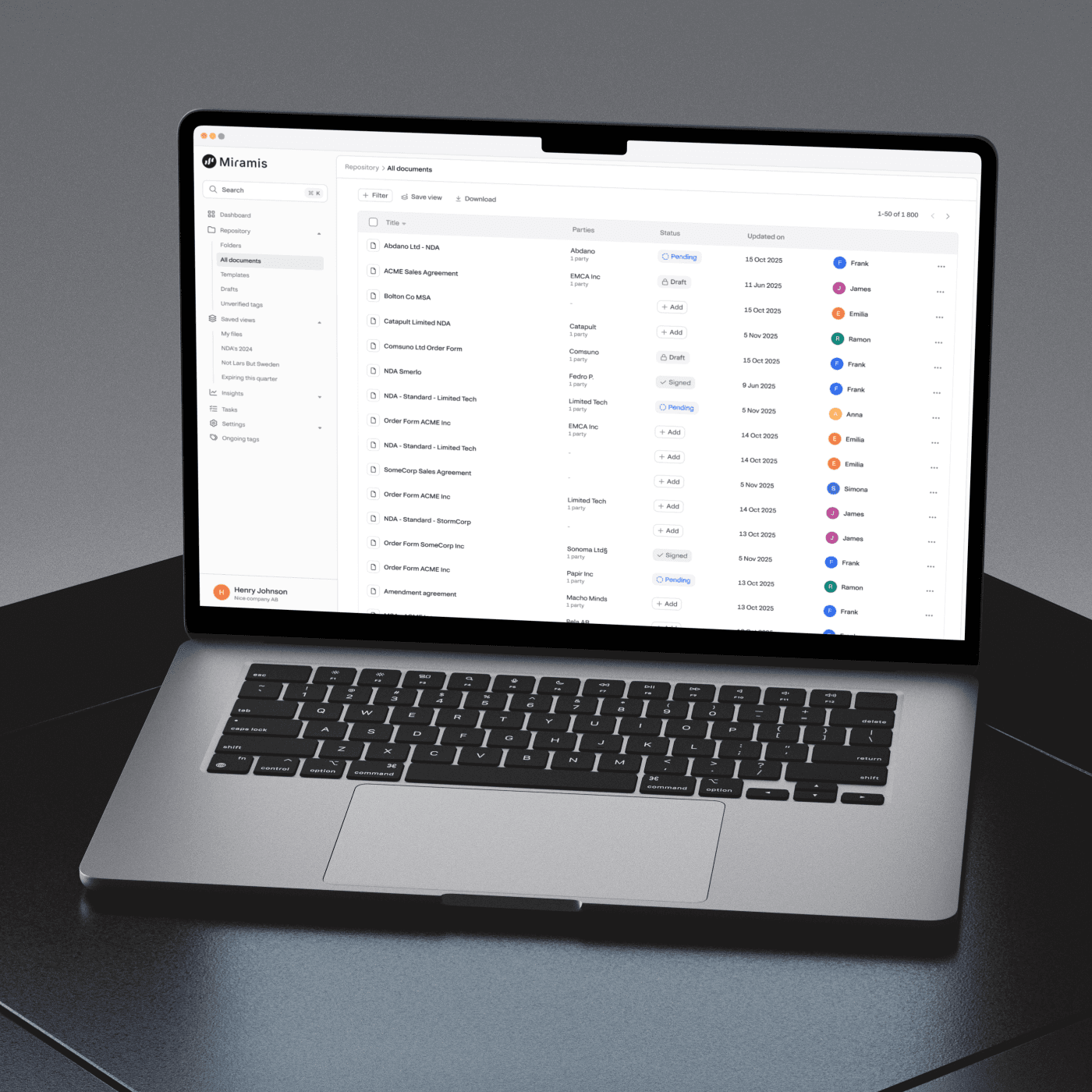
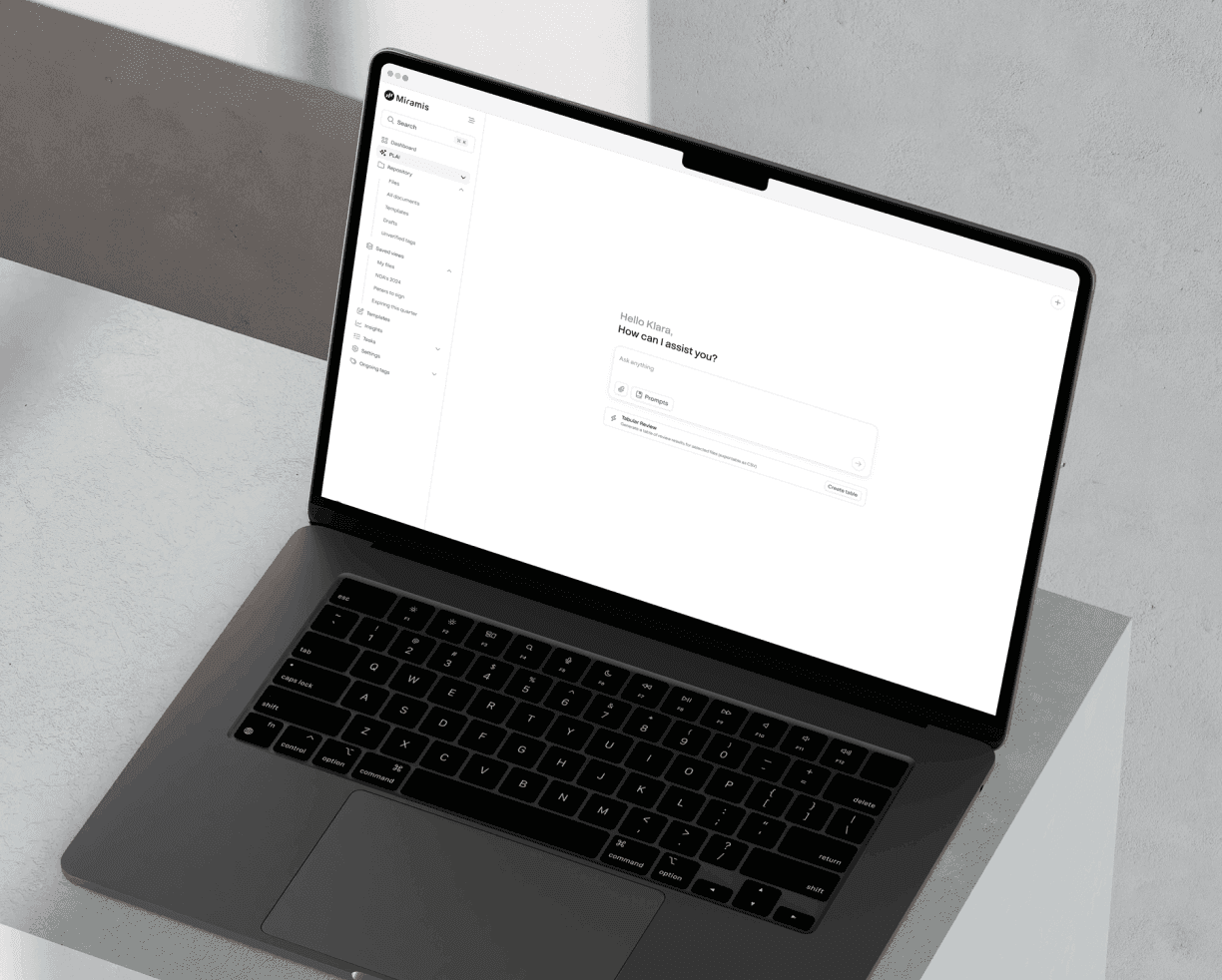
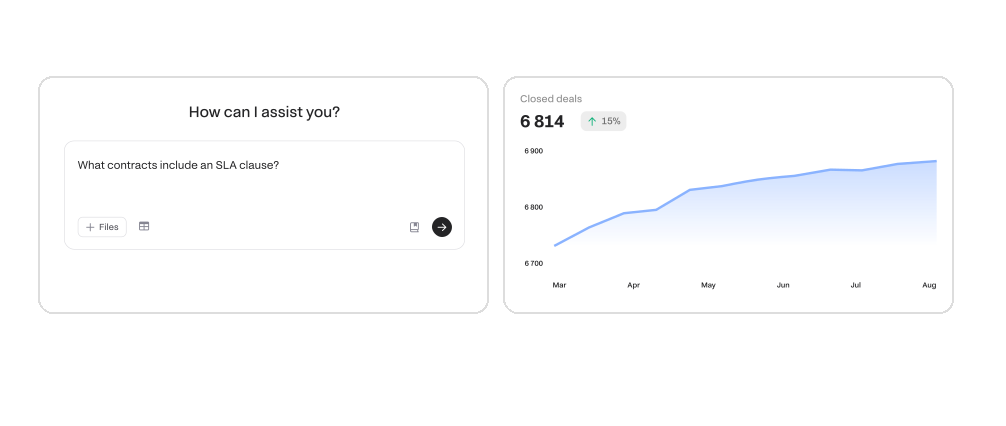
AI-based contract management software Pocketlaw for businesses of all sizes (small, medium, large), showcasing a user-friendly dashboard that streamlines legal workflow for clients and customers with options to create, review, and upload documents, access templates, and monitor document statistics.

Frequently Asked Questions

What are Ironclad's main competitors in CLM?

Ironclad's main competitors in the contract lifecycle management space include Miramis, Conga, DocuSign CLM, Icertis, Agiloft, ContractPodAi (now Leah), Evisort (now part of Workday), Juro, and PandaDoc. Each platform serves different combinations of team size, geography, and primary use case - from European mid-market full-lifecycle CLM to enterprise procurement-led platforms.

Is Ironclad a good company?

Ironclad is a robust enterprise CLM platform with strong workflow automation, recognised customers (L'Oréal, OpenAI, Cisco, Asana, Dropbox), and integrated AI features. Reviewers praise its workflow designer while citing concerns around 3-6 month implementation timelines, US-centric architecture, and pricing in the $50,000-$120,000+ range for mid-market enterprise deployments.

What is the difference between Miramis and Ironclad?

Miramis is built for European mid-market and enterprise teams with native BankID, MitID, and GDPR-first architecture, and is designed for the whole business (Sales, HR, Procurement) to self-serve within legal guardrails. Ironclad is built primarily for US enterprise legal operations teams with workflow design and template management run by legal.

What is the difference between DocuSign and Ironclad?

DocuSign CLM extends the DocuSign eSignature ecosystem into full contract workflow management - the natural choice for organisations already running DocuSign widely. Ironclad operates as a standalone CLM with native eSigning, designed primarily for legal operations teams managing contracts across multiple business systems.

What is the difference between Ironclad and Icertis?

Icertis serves Fortune 500 procurement-heavy organisations with deep ERP integration (SAP, Oracle) and multi-language support across 90+ countries. Ironclad serves enterprise legal operations teams with strong workflow design and Salesforce-led sales contracting. Both are recognised CLM leaders by Gartner, but optimise for different use cases.

How long does Miramis implementation take compared to Ironclad?

Miramis is implemented in weeks using AI-powered onboarding - bulk legacy contract import with automatic metadata extraction, template suggestions, and self-serve configuration. Ironclad enterprise deployments typically run 3-6 months, with workflow setup, template configuration, and team training requiring significant internal resources and dedicated legal operations support.

AI-based contract management software Pocketlaw for businesses of all sizes (small, medium, large), showcasing a user-friendly dashboard that streamlines legal workflow for clients and customers with options to create, review, and upload documents, access templates, and monitor document statistics.

Frequently Asked Questions

What are Ironclad's main competitors in CLM?

Ironclad's main competitors in the contract lifecycle management space include Miramis, Conga, DocuSign CLM, Icertis, Agiloft, ContractPodAi (now Leah), Evisort (now part of Workday), Juro, and PandaDoc. Each platform serves different combinations of team size, geography, and primary use case - from European mid-market full-lifecycle CLM to enterprise procurement-led platforms.

Is Ironclad a good company?

Ironclad is a robust enterprise CLM platform with strong workflow automation, recognised customers (L'Oréal, OpenAI, Cisco, Asana, Dropbox), and integrated AI features. Reviewers praise its workflow designer while citing concerns around 3-6 month implementation timelines, US-centric architecture, and pricing in the $50,000-$120,000+ range for mid-market enterprise deployments.

What is the difference between Miramis and Ironclad?

Miramis is built for European mid-market and enterprise teams with native BankID, MitID, and GDPR-first architecture, and is designed for the whole business (Sales, HR, Procurement) to self-serve within legal guardrails. Ironclad is built primarily for US enterprise legal operations teams with workflow design and template management run by legal.

What is the difference between DocuSign and Ironclad?

DocuSign CLM extends the DocuSign eSignature ecosystem into full contract workflow management - the natural choice for organisations already running DocuSign widely. Ironclad operates as a standalone CLM with native eSigning, designed primarily for legal operations teams managing contracts across multiple business systems.

What is the difference between Ironclad and Icertis?

Icertis serves Fortune 500 procurement-heavy organisations with deep ERP integration (SAP, Oracle) and multi-language support across 90+ countries. Ironclad serves enterprise legal operations teams with strong workflow design and Salesforce-led sales contracting. Both are recognised CLM leaders by Gartner, but optimise for different use cases.

How long does Miramis implementation take compared to Ironclad?

Miramis is implemented in weeks using AI-powered onboarding - bulk legacy contract import with automatic metadata extraction, template suggestions, and self-serve configuration. Ironclad enterprise deployments typically run 3-6 months, with workflow setup, template configuration, and team training requiring significant internal resources and dedicated legal operations support.

AI-based contract management software Pocketlaw for businesses of all sizes (small, medium, large), showcasing a user-friendly dashboard that streamlines legal workflow for clients and customers with options to create, review, and upload documents, access templates, and monitor document statistics.

Compare Miramis to Your Shortlist

Compare Miramis to Your Shortlist

Book a personalised demo and see how Miramis handles your full contract lifecycle - native eIDAS eSigning with BankID, AI contract agent across every workflow, intelligent repository with natural language search, and implementation that delivers value in weeks. Migration support and dedicated onboarding included.

Book a personalised demo and see how Miramis handles your full contract lifecycle - native eIDAS eSigning with BankID, AI contract agent across every workflow, intelligent repository with natural language search, and implementation that delivers value in weeks. Migration support and dedicated onboarding included.