7 Leah Alternatives for AI-Native Contract Management

7 Leah Alternatives for AI-Native Contract Management

7 Leah Alternatives for AI-Native Contract Management

7 Leah Alternatives for AI-Native Contract Management

Leah (formerly ContractPodAi) is an enterprise agentic AI platform positioning itself as a connected system for legal, contracts, and procurement. The product was rebranded from ContractPodAi in 2024-2025 and now markets itself as more than a CLM: an "agentic operating system" of autonomous domain agents and self-healing workflows. Leah targets large enterprises - customers include KPMG, PwC, Alaska Airlines, and Philips - and competes directly with Sirion, Ironclad, and DocuSign CLM in the upper end of the contract management market.

Leah (formerly ContractPodAi) is an enterprise agentic AI platform positioning itself as a connected system for legal, contracts, and procurement. The product was rebranded from ContractPodAi in 2024-2025 and now markets itself as more than a CLM: an "agentic operating system" of autonomous domain agents and self-healing workflows. Leah targets large enterprises - customers include KPMG, PwC, Alaska Airlines, and Philips - and competes directly with Sirion, Ironclad, and DocuSign CLM in the upper end of the contract management market.

Leah (formerly ContractPodAi) is an enterprise agentic AI platform positioning itself as a connected system for legal, contracts, and procurement. The product was rebranded from ContractPodAi in 2024-2025 and now markets itself as more than a CLM: an "agentic operating system" of autonomous domain agents and self-healing workflows. Leah targets large enterprises - customers include KPMG, PwC, Alaska Airlines, and Philips - and competes directly with Sirion, Ironclad, and DocuSign CLM in the upper end of the contract management market.

How These Leah Alternatives Compare

How These Leah Alternatives Compare

The right Leah alternative depends on AI architecture depth, lifecycle coverage, and whether the platform is built for business-team self-serve or for legal operations specialists. The summary below compares the seven strongest alternatives at a glance.

ToolAI ArchitectureFull LifecycleBusiness Team Self-ServeBest For
MiramisPopular choice
AI-native (PLAI built in)Yes - create through analyseYes - Sales, HR, ProcurementMid-market (200-5,000 employees)
Ironclad
AI features integratedYesLimited - legal-team focusLarge enterprise legal ops
DocuSign CLM
AI features integratedYesPartialEnterprises in DocuSign ecosystem
Sirion
AI-native analyticsContract management + analyticsLimited - legal/procurementEnterprise, complex portfolios
LinkSquares
AI-native analyticsRepository + workflowLegal teams primarilyLegal teams, contract intelligence
Juro
AI features integratedYes - legal-team focusLimitedIn-house legal, European market
Concord
Basic AIYes (simpler scope)PartialTeams prioritising simplicity
Comparison based on publicly available product information from G2, Gartner Peer Insights, Capterra, and vendor documentation.

The 7 Best Leah CLM Alternatives

The 7 Best Leah CLM Alternatives

02
Ironclad
Best for US Enterprises with Complex Workflows

Ironclad is an enterprise CLM with a broad workflow automation feature set, strong brand recognition in the US market, and a large enterprise customer base including L'Oréal, OpenAI, Cisco, Asana, and Dropbox. The platform covers the full contract lifecycle and offers integrations across sales, procurement, and legal stacks, with strong native Salesforce integration. Like Leah, Ironclad is built primarily around legal teams as the primary operators of the platform - workflow design, template management, and approvals are largely configured and run by legal.

Ironclad is best suited for large enterprises with dedicated legal operations teams and the IT resources to manage a complex CLM deployment over a typical 3-6 month timeline. Pricing for mid-market deployments runs $50,000-$120,000/year (per Vendr data), with implementation fees and AI add-ons charged separately. Teams where Sales, HR, and Procurement need to self-serve on standard contracts without legal involvement on every request may find the legal-team-centric model creates similar bottlenecks to what they had before.

03
DocuSign CLM

DocuSign CLM is an enterprise contract lifecycle management platform that extends the DocuSign eSignature ecosystem into full contract workflow management. For organisations already running DocuSign for eSigning, it offers continuity - contract creation, review, approval, and signing within a single vendor relationship. The platform carries enterprise-grade integrations, particularly with Salesforce, and benefits from DocuSign's established position in procurement and legal workflows.

A critical detail: Docusign CLM does not include eSignature. The two products require separate subscriptions despite the brand connection. DocuSign CLM is best suited for enterprises already invested in the DocuSign ecosystem that want to extend into contract lifecycle workflows without changing their signing infrastructure. Teams evaluating it as a standalone CLM - rather than as an extension of existing DocuSign use - may find the value proposition less compelling outside the broader product suite.

04
Sirion

Sirion is the AI-native enterprise CLM platform with particular depth in post-sign contract analytics, obligation monitoring, and complex procurement portfolios. The company's AI engine has been built organically over 15+ years of dedicated R&D in CLM, with an agentic architecture spanning purpose-built agents (Extraction, Redline, AskSirion). Customers include IBM, Vodafone, Qantas, and Schneider Electric. Sirion is consistently recognised as a 3x Gartner Magic Quadrant Leader for CLM and is a direct Leah competitor in the enterprise analytics dimension.

Sirion is best suited for large enterprises - particularly in financial services, manufacturing, and procurement-heavy industries - managing complex contract portfolios where post-sign obligation monitoring and supplier performance tracking are primary operational needs. Reviewers consistently note a learning curve for new users and significant cutover time during implementation. Implementation requirements and enterprise positioning make it less suited for mid-market teams or those prioritising business team self-serve over deep analytics.

05
LinkSquares
Best for post-signature analytics

LinkSquares is an AI-native contract analytics and management platform with a strong focus on extracting intelligence from existing contract archives. The AI is designed to ingest, tag, and surface insights from large repositories of signed contracts - making it useful for legal teams that need visibility into what they have signed, what obligations are active, and what risks exist across the portfolio. AI features are bundled into base pricing rather than charged as add-ons.

LinkSquares is best suited for enterprise legal teams prioritising AI-powered visibility into existing contract archives over end-to-end contract workflow automation. The platform's strength is post-signature analysis and repository intelligence; pre-sign workflow capabilities are less developed than dedicated full-lifecycle CLMs. Teams evaluating it as a direct Leah replacement should confirm the depth of pre-sign workflow and business team self-serve capabilities against their specific use case.

06
Juro
Best for UK-based sales-led teams

Juro is a London-based CLM built around in-house legal teams, with a browser-native contract editor as its notable product feature. The platform covers contract creation, collaboration, and signing in a clean interface designed for legal teams drafting and negotiating contracts. Juro has a meaningful presence in the European market and is positioned as a simpler alternative to heavy enterprise CLMs. AI Assistant is included on every pricing plan.

Juro is best suited for in-house legal teams - particularly in Europe - looking for a cleaner contract creation and collaboration experience than enterprise CLMs typically deliver. Teams evaluating it as a direct Leah replacement should assess whether its AI capabilities match the depth they are used to from Leah's agentic architecture, and whether the legal-team-centric design supports the cross-functional adoption they need. Limited customisation depth for complex enterprise workflows and no native Nordic eID support.

07
Concord

Concord is a contract management platform covering contract creation, redlining, negotiation, and signing in one interface, deliberately built for SMB and mid-market simplicity rather than enterprise complexity. Founded in 2014 with offices in Austin and Paris, Concord serves 1,500+ SMB and mid-market organisations (50-1,000 employees), with 65% of customers having no legal team. Transparent pricing starts at $399/month for the Essentials plan with AI Copilot, unlimited documents, and unlimited eSignatures included.

Concord is best suited for teams wanting straightforward contract management without enterprise-grade overhead - where simplicity, transparent pricing, and fast implementation are the primary requirements. Teams moving from Leah's agentic AI architecture who need comparable AI depth - contract intelligence, autonomous workflows, cross-functional coverage at scale - should evaluate whether Concord's simpler feature set matches those requirements. The platform is intentionally less sophisticated than enterprise CLMs, which is its strength for SMBs and its limitation for teams that have outgrown them.

See How Miramis Compares

See How Miramis Compares

See How Miramis Compares

If you're comparing AI-native CLM options after evaluating Leah, Miramis is worth seeing in context. Book a 30-minute walkthrough and see PLAI, full lifecycle workflows, and intelligent repository running with your contract types and your team structure - not a generic demo.

Why Teams Look for Leah CLM Alternatives

Why Teams Look for Leah CLM Alternatives

Why Teams Look for Leah CLM Alternatives

Trusted by 1000+ teams

Why European Teams Choose Miramis

Why European Teams Choose Miramis

Why European Teams Choose Miramis

Enterprise-Ready from Day One

Built for enterprise security review. Your data is never used to train AI models.

ISO 27001

SOC 2

GDPR-native

eIDAS-compliant

SSO / SAML

European data residency

Frequently Asked Questions

What is Leah (ContractPodAi)?

Leah (formerly ContractPodAi) is an enterprise agentic AI platform that positions itself as a connected system for legal, contracts, and procurement. The company rebranded from ContractPodAi in 2024-2025 and now markets the platform as an "agentic operating system" with autonomous domain agents and self-healing workflows. Leah targets large enterprises including KPMG, PwC, Alaska Airlines, and Philips.

What should you look for in a Leah alternative?

A strong Leah alternative covers the full contract lifecycle with AI-native architecture and supports business team self-serve - not just legal operations. The five evaluation criteria that matter: AI architecture (genuinely AI-native vs. bolted-on AI), full lifecycle coverage, business team self-serve capabilities, implementation speed, and market fit (enterprise-only vs. mid-market accessible).

How long does Miramis implementation take?

Miramis is implemented in weeks using AI-powered onboarding rather than the 5-month average for Leah. Bulk legacy contract import with automatic metadata extraction, template suggestions, and self-serve configuration replace traditional six-month deployments. Most teams reach value in weeks rather than months.

Is Miramis suitable for mid-market companies evaluating enterprise CLM?

Miramis is purpose-built for mid-market companies (200-5,000 employees) needing AI-native CLM without enterprise overhead. The platform covers the full contract lifecycle with PLAI as an AI contract agent and self-serve workflows for Sales, HR, Procurement, and Legal - the scale where enterprise CLM platforms are typically a poor fit and SMB tools become bottlenecks.

How does Ironclad compare to Leah?

Ironclad covers enterprise contract workflow automation with legal teams as the primary user base, similar to Leah's architectural approach. Both platforms are designed for large enterprises with dedicated legal operations resources. The key difference: Ironclad has stronger Salesforce-led sales contracting workflows, while Leah leans more heavily on agentic AI orchestration across procurement and legal.

Is Sirion an AI-native CLM like Miramis?

Yes. Sirion is an AI-native CLM with 15+ years of dedicated CLM R&D and an agentic architecture comparable to Miramis's PLAI. The key difference is market fit: Sirion is built for very large enterprises managing complex global portfolios (IBM, Vodafone, Qantas), while Miramis is purpose-built for mid-market companies needing the same AI-native architecture without enterprise complexity.

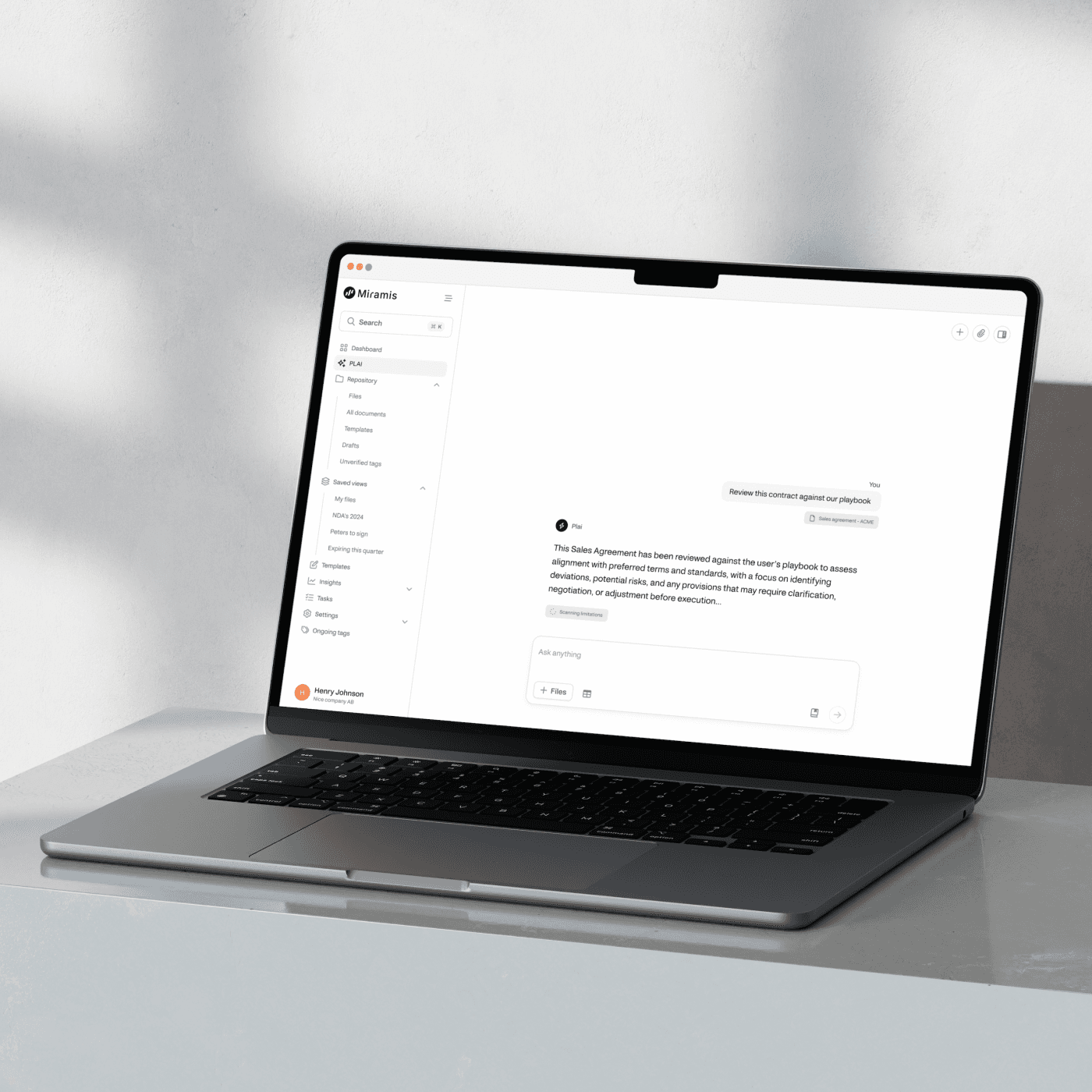
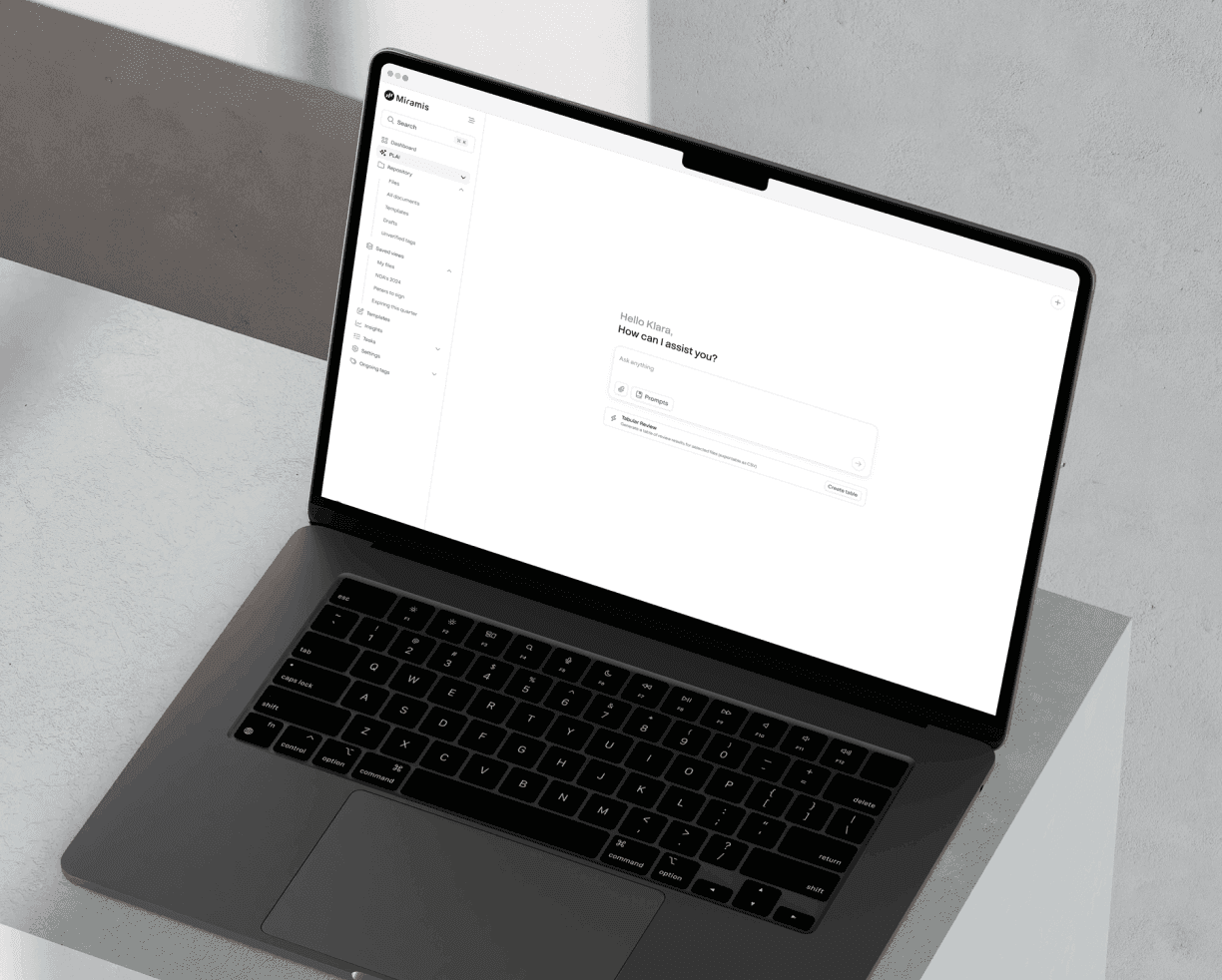
AI-based contract management software Pocketlaw for businesses of all sizes (small, medium, large), showcasing a user-friendly dashboard that streamlines legal workflow for clients and customers with options to create, review, and upload documents, access templates, and monitor document statistics.

Frequently Asked Questions

What is Leah (ContractPodAi)?

Leah (formerly ContractPodAi) is an enterprise agentic AI platform that positions itself as a connected system for legal, contracts, and procurement. The company rebranded from ContractPodAi in 2024-2025 and now markets the platform as an "agentic operating system" with autonomous domain agents and self-healing workflows. Leah targets large enterprises including KPMG, PwC, Alaska Airlines, and Philips.

What should you look for in a Leah alternative?

A strong Leah alternative covers the full contract lifecycle with AI-native architecture and supports business team self-serve - not just legal operations. The five evaluation criteria that matter: AI architecture (genuinely AI-native vs. bolted-on AI), full lifecycle coverage, business team self-serve capabilities, implementation speed, and market fit (enterprise-only vs. mid-market accessible).

How long does Miramis implementation take?

Miramis is implemented in weeks using AI-powered onboarding rather than the 5-month average for Leah. Bulk legacy contract import with automatic metadata extraction, template suggestions, and self-serve configuration replace traditional six-month deployments. Most teams reach value in weeks rather than months.

Is Miramis suitable for mid-market companies evaluating enterprise CLM?

Miramis is purpose-built for mid-market companies (200-5,000 employees) needing AI-native CLM without enterprise overhead. The platform covers the full contract lifecycle with PLAI as an AI contract agent and self-serve workflows for Sales, HR, Procurement, and Legal - the scale where enterprise CLM platforms are typically a poor fit and SMB tools become bottlenecks.

How does Ironclad compare to Leah?

Ironclad covers enterprise contract workflow automation with legal teams as the primary user base, similar to Leah's architectural approach. Both platforms are designed for large enterprises with dedicated legal operations resources. The key difference: Ironclad has stronger Salesforce-led sales contracting workflows, while Leah leans more heavily on agentic AI orchestration across procurement and legal.

Is Sirion an AI-native CLM like Miramis?

Yes. Sirion is an AI-native CLM with 15+ years of dedicated CLM R&D and an agentic architecture comparable to Miramis's PLAI. The key difference is market fit: Sirion is built for very large enterprises managing complex global portfolios (IBM, Vodafone, Qantas), while Miramis is purpose-built for mid-market companies needing the same AI-native architecture without enterprise complexity.

AI-based contract management software Pocketlaw for businesses of all sizes (small, medium, large), showcasing a user-friendly dashboard that streamlines legal workflow for clients and customers with options to create, review, and upload documents, access templates, and monitor document statistics.

Frequently Asked Questions

What is Leah (ContractPodAi)?

Leah (formerly ContractPodAi) is an enterprise agentic AI platform that positions itself as a connected system for legal, contracts, and procurement. The company rebranded from ContractPodAi in 2024-2025 and now markets the platform as an "agentic operating system" with autonomous domain agents and self-healing workflows. Leah targets large enterprises including KPMG, PwC, Alaska Airlines, and Philips.

What should you look for in a Leah alternative?

A strong Leah alternative covers the full contract lifecycle with AI-native architecture and supports business team self-serve - not just legal operations. The five evaluation criteria that matter: AI architecture (genuinely AI-native vs. bolted-on AI), full lifecycle coverage, business team self-serve capabilities, implementation speed, and market fit (enterprise-only vs. mid-market accessible).

How long does Miramis implementation take?

Miramis is implemented in weeks using AI-powered onboarding rather than the 5-month average for Leah. Bulk legacy contract import with automatic metadata extraction, template suggestions, and self-serve configuration replace traditional six-month deployments. Most teams reach value in weeks rather than months.

Is Miramis suitable for mid-market companies evaluating enterprise CLM?

Miramis is purpose-built for mid-market companies (200-5,000 employees) needing AI-native CLM without enterprise overhead. The platform covers the full contract lifecycle with PLAI as an AI contract agent and self-serve workflows for Sales, HR, Procurement, and Legal - the scale where enterprise CLM platforms are typically a poor fit and SMB tools become bottlenecks.

How does Ironclad compare to Leah?

Ironclad covers enterprise contract workflow automation with legal teams as the primary user base, similar to Leah's architectural approach. Both platforms are designed for large enterprises with dedicated legal operations resources. The key difference: Ironclad has stronger Salesforce-led sales contracting workflows, while Leah leans more heavily on agentic AI orchestration across procurement and legal.

Is Sirion an AI-native CLM like Miramis?

Yes. Sirion is an AI-native CLM with 15+ years of dedicated CLM R&D and an agentic architecture comparable to Miramis's PLAI. The key difference is market fit: Sirion is built for very large enterprises managing complex global portfolios (IBM, Vodafone, Qantas), while Miramis is purpose-built for mid-market companies needing the same AI-native architecture without enterprise complexity.

AI-based contract management software Pocketlaw for businesses of all sizes (small, medium, large), showcasing a user-friendly dashboard that streamlines legal workflow for clients and customers with options to create, review, and upload documents, access templates, and monitor document statistics.

Compare Miramis to Your Shortlist

Compare Miramis to Your Shortlist

Book a personalised demo and see how Miramis handles your full contract lifecycle - native eIDAS eSigning with BankID, AI contract agent across every workflow, intelligent repository with natural language search, and implementation that delivers value in weeks. Migration support and dedicated onboarding included.

Book a personalised demo and see how Miramis handles your full contract lifecycle - native eIDAS eSigning with BankID, AI contract agent across every workflow, intelligent repository with natural language search, and implementation that delivers value in weeks. Migration support and dedicated onboarding included.