
Contract drafting follows five stages: contract initiation, creation and negotiation, approval, execution, and monitoring and management. Each stage has defined inputs, outputs, and responsible parties, making the process repeatable and auditable across every agreement type.
A defined drafting workflow reduces the risk of missed obligations, inconsistent terms, and approval gaps. When each stage has clear ownership and exit criteria, legal teams spend less time chasing progress and more time on the agreements that require their attention.
The same workflow logic applies across types of contracts, from sales agreements and supplier terms to employment contracts and NDAs. What changes is the complexity and the parties involved. The stages remain the same.
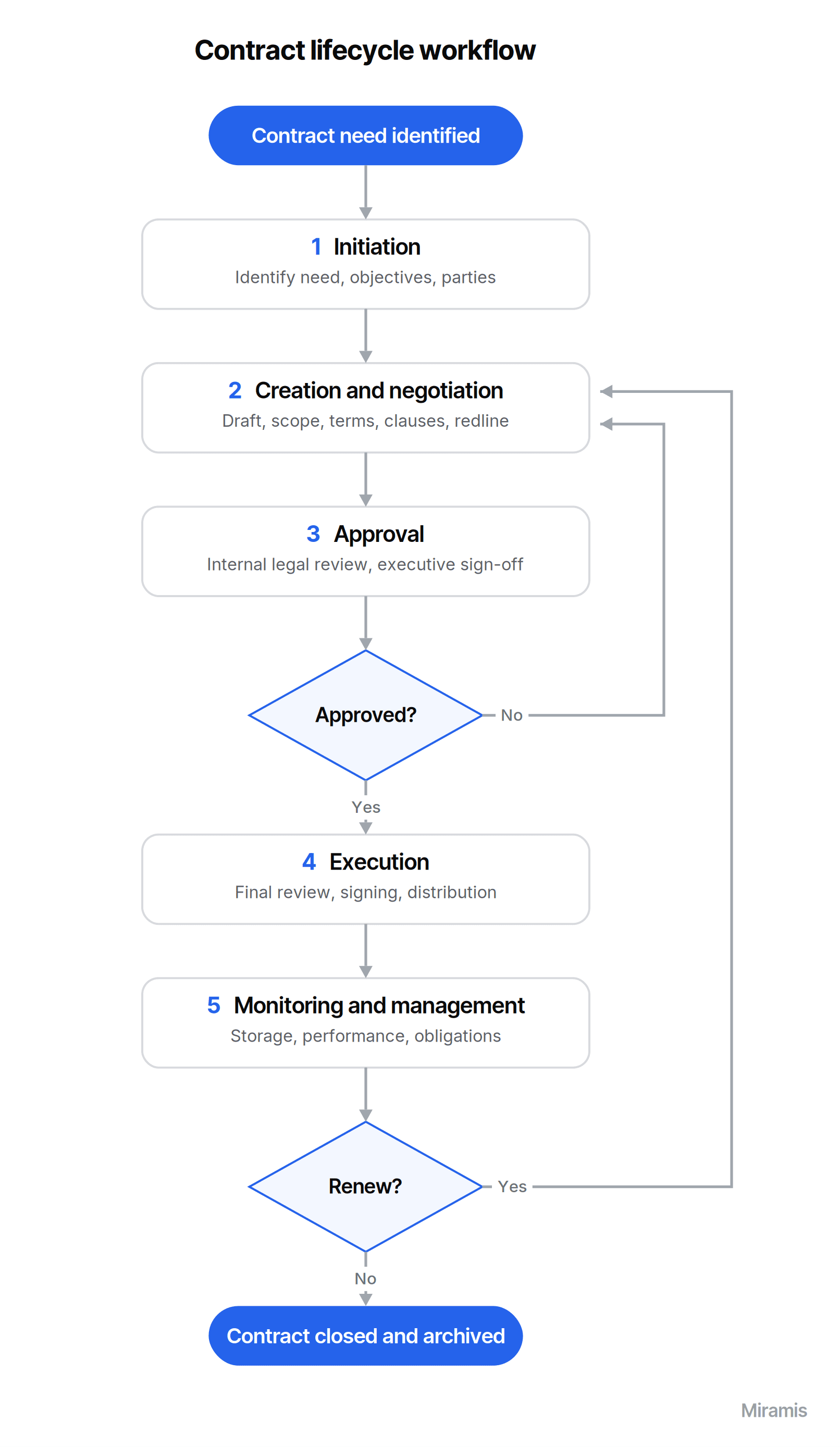
Stage 1: Contract Initiation
Contract initiation establishes the business context for an agreement before drafting begins. It confirms what kind of contract is needed, who the parties are, and what the agreement is intended to achieve.
Getting this stage right prevents rework later. A request that arrives without clear objectives or unverified party details forces the drafting team to stop and investigate, adding days before a single clause is written.
Identify the Need
The need for a contract arises when two or more parties enter a commercial, employment, or service relationship that creates mutual obligations. Common triggers include a new sale, a supplier engagement, a new hire, or a project with significant financial or legal exposure.
Not every transaction requires a bespoke agreement. Many organisations use pre-approved contract templates as the starting point for recurring relationships, reducing drafting time without reducing legal rigour.
Define Objectives
Contract objectives define what both parties expect to achieve from the relationship. This includes commercial outcomes, performance standards, and any compliance requirements the agreement must satisfy.
Documenting objectives at this stage shapes everything that follows. A contract drafted without a clear business purpose is harder to negotiate, more likely to be disputed, and less useful as a reference once signed.
Identify Parties
The parties to a contract must be identified using their full legal names, registered addresses, and entity types. Using a trading name or informal reference risks creating an agreement that is difficult to enforce.
For corporate agreements, this means confirming the registered company name, jurisdiction of incorporation, and who holds signing authority. That determines who must appear in the signature block and who can legally bind the organisation.
Stage 2: Contract Creation and Negotiation
Contract creation and negotiation is where the agreement takes shape. This stage moves from the objectives defined at initiation through to a version both parties are prepared to sign.
It is also the stage with the most moving parts. Multiple drafts, tracked changes, and revisions between legal teams can make this the slowest part of the process or, with the right workflow, one of the most manageable.
Outline Key Terms
Key terms are the commercial and legal provisions that must be resolved before drafting begins. Identifying them upfront avoids mid-draft surprises that reopen negotiations once the document is nearly complete.
For most commercial agreements, key terms include scope of services, fees and payment schedule, contract duration, liability limits, and termination rights. For employment agreements, they shift to compensation, notice periods, and restrictive covenants.
Draft the First Draft
The first draft of a contract is a working document, not a final position. Knowing how to draft a contract in practice means capturing the agreed commercial terms in legally structured language before the revision cycle begins.
Starting from a pre-approved template is standard practice for most organisations. Templates ensure standard protective clauses are already in place, reducing the time legal spends on boilerplate before negotiation begins.
Define Scope and Deliverables
Scope and deliverables define what each party is obligated to deliver, by when, and to what standard. Vague scope language is one of the most common sources of contract disputes.
For service agreements, this means specifying milestones, acceptance criteria, and the process for handling changes after the contract is signed. If the agreement cannot answer “who does what and by when,” it will require renegotiation at the point of delivery.
Establish Terms and Conditions
Terms and conditions govern the commercial framework of the agreement. This includes payment terms, liability caps, indemnification obligations, and the applicable governing law.
These provisions are often the most negotiated in B2B agreements. Both parties enter with a preferred position, and the negotiation process determines where each clause lands.
Incorporate Essential Clauses
Essential clauses are the standard legal provisions that protect both parties regardless of the commercial context. These include confidentiality obligations, intellectual property ownership, limitation of liability, and termination clauses.
Omitting essential clauses is a common risk in contracts drafted quickly or from an outdated template. A contract without a clear dispute resolution mechanism leaves both parties without an agreed path if the relationship breaks down.
Review and Redline
Redlining is the process of marking proposed changes directly on a draft so both parties can see exactly what has changed between versions. It is the standard method for collaborative contract review across most commercial relationships.
Contract redlining follows a clear cycle: each party reviews the current version, proposes changes with tracked edits, provides brief explanations for substantive changes, and returns the marked draft within an agreed timeframe.
Negotiate Terms
Contract negotiation is the process by which both parties move from their opening positions to a final agreed version. Most commercial negotiations focus on liability limits, payment terms, IP ownership, and termination rights.
Most negotiations go through two to four rounds of redlines before a final version is reached. The goal is a document both parties understand and are prepared to sign, not the best possible outcome for one side at the expense of the other.
Teams managing high contract volumes benefit from a documented playbook that sets out pre-approved fallback positions for the most commonly disputed clauses. Miramis embeds negotiation playbooks directly into its contract workflow automation, so every round of redlines stays within legal-approved parameters without requiring legal sign-off on each exchange.
Stage 3: Contract Approval
Contract approval is the internal process of confirming that an agreement is ready to be signed. It verifies legal compliance, assesses commercial risk, and ensures the right decision-makers have authorised the commitment.
Approval requirements vary by organisation and contract type. A low-value services agreement may need only the department head. A significant supplier contract or multi-year commitment requires sign-off from legal, finance, and senior leadership.
Internal Legal Review
Internal legal review confirms that a contract’s terms comply with applicable law, meet the organisation’s risk standards, and do not expose the business to unacceptable liability. Legal review is not about adjusting terms. It verifies that the agreed terms are safe to execute.
Legal teams reviewing contracts at this stage check for regulatory compliance, governing law clauses, IP ownership clarity, and any indemnification language that creates disproportionate risk. Issues identified here trigger a return to negotiation before the approval process can advance.
Executive Approval
Executive approval secures the organisational authority required for a contract to become a binding commitment. Who holds that authority depends on the value and nature of the agreement, defined by a delegation of authority framework that most organisations maintain as standard governance.
Without a clear approval matrix, contracts either stall while decision-makers are identified or move forward without proper authorisation. Both outcomes create risk. When approval routing is automated, every contract reaches the right signatory based on the agreement’s value, type, and counterparty risk level.
Miramis routes each contract to the correct approvers automatically through configurable approval workflows on the contract lifecycle management platform. Legal guardrails are set once and applied to every agreement, so the executive team approves what it needs to and routine contracts move forward without manual routing.
Stage 4: Contract Execution
Contract execution is the point at which both parties formally commit to the agreement by signing. It is the final step before a contract becomes legally binding and obligations begin to accrue.
A signed contract without proper execution steps creates operational problems immediately. Final version confirmation, correct signatories, and distributed copies are all required before the execution stage can be considered complete.
Final Review and Signing
The final review confirms that the version being signed reflects the last agreed draft and that the signature block names the correct parties with the correct authority. This check takes minutes but prevents disputes that can take months to resolve.
Signing can be completed by wet signature on a printed document or by electronic signature via an eIDAS-compliant eSigning tool. Electronic signatures carry the same legal force as physical ones in most jurisdictions, provided the signing method meets the applicable regulatory standard.
Distribution
Distribution ensures that every party to the agreement receives a fully executed copy immediately after signing. A signed contract that sits in one party’s email without being distributed to the counterparty creates a practical and legal gap.
The distributed copy should be the final executed version: signed by all parties, dated, and stored in a format that cannot be edited. For significant financial commitments, distribution should also reach internal stakeholders in finance, procurement, and the responsible business unit.
Miramis routes executed copies to all named parties and stakeholders immediately after the last signature is applied, eliminating the manual distribution step and the risk of a signed contract going untracked in a shared folder.
Stage 5: Contract Monitoring and Management
Contract monitoring and management begins the moment a contract is executed. This stage covers tracking obligations, managing performance, and preparing for renewal or termination.
For many organisations, this is the least developed part of the contract lifecycle. Contracts get signed and filed, and obligations are tracked in spreadsheets or not at all. The cost is measured in missed renewals, breached obligations, and unquantified financial exposure.
Storage
Contract storage means maintaining executed agreements in a centralised, searchable repository with access controls, version history, and metadata tagging that makes retrieval fast and audits straightforward.
Contracts stored across email threads, shared drives, and individual folders create the conditions for missed obligations, duplicate agreements, and failed audits. A contract repository is the operational foundation that makes every other part of post-signature management possible.
Performance Monitoring
Contract monitoring tracks whether both parties are meeting their obligations on time and to the agreed standard. This includes delivery milestones, payment schedules, service level commitments, and compliance requirements embedded in the contract.
Performance monitoring requires that obligations are extracted from the contract and tracked as discrete, measurable items. When an obligation falls behind schedule, the responsible party must be notified before it becomes a breach, not after.
Renewal or Termination
Contract renewal and termination are the two possible outcomes at the end of a contract’s term. Renewal extends the agreement on the original or revised terms. Termination ends the relationship, requiring adherence to the notice procedures and end-of-term obligations set out in the agreement.
Both outcomes require advance planning. Renewal decisions need time to renegotiate terms and obtain approvals. Termination requires adequate notice and, depending on the agreement, wind-down obligations and data handling steps.
Allowing a contract to auto-renew without review is a common source of unwanted commitments and overpayments. Miramis tracks renewal dates and sends automated alerts well in advance, giving legal and procurement teams time to act rather than react.

Disclaimer:
Please note: Miramis is not a substitute for an attorney or law firm. So, should you have any legal questions on the content of this page, please get in touch with a qualified legal professional.
Related articles

Claude Use Cases for Lawyers: 10 Applications, Prompts & Limitations
Explore 10 Claude use cases for lawyers: legal research, contract review, document drafting, due diligence. Includes prompts, limitations, and when purpose-built CLM is better.

Aleatory Contracts Explained: Types and Industry Use Copy
An aleatory contract is a binding agreement where obligations and benefits depend on uncertain future events, like insurance or gambling contracts.

10 ChatGPT Use Cases for Lawyers & Legal Teams
Discover how ChatGPT enhances legal research, drafting, and compliance while understanding its limitations and the best ways to use AI effectively in legal practice.