
Contract review is the examination of an agreement’s terms before signing to confirm they are clear, fair, and legally sound. It covers compliance with contract law, the obligations and rights each party takes on, and risks such as breach or uncapped liability.
The review protects the interests of the business and confirms the agreement is enforceable. Catching an ambiguous term before signature costs an hour. Resolving the same ambiguity afterwards, once both sides have acted on conflicting readings, costs considerably more.
To review a contract, work through a defined sequence: prepare and set objectives, analyse the key provisions, review the important commercial clauses, run an AI-assisted first pass where one is available, check legal compliance, address execution formalities, plan the negotiation, obtain final approval, and manage the contract after signing.
Contract review matters because it is the last point at which terms can still be changed at no cost. Once signed, an unfavourable clause is a commitment. Review is also where all parties confirm they read the agreement the same way : which is what prevents most disputes.
The step most affected by recent change is the first pass. Legal technology has moved from a stated ambition to an operating reality across in-house teams.
Thomson Reuters’ 2026 State of the Corporate Law Department, based on interviews with more than 2,400 General Counsel, found technology mentions as a strategic priority doubled from 14% to 28% in a year : and 86% of those mentions referred specifically to AI.
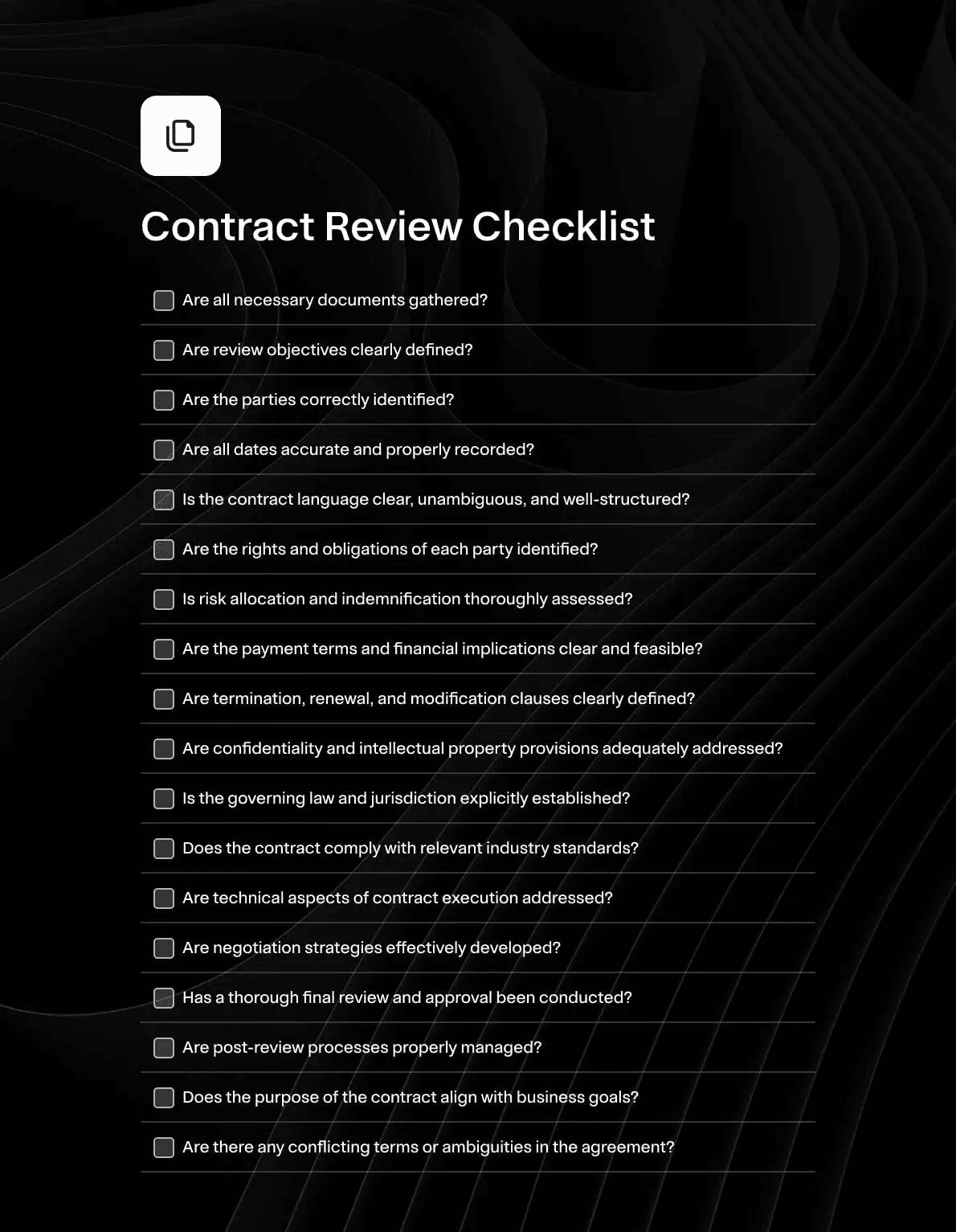
Contract Review Checklist
Gather necessary documents
Set review objectives
Decide who reviews the contract
Ensure parties are correctly identified
Verify all dates are accurate and properly recorded
Examine contract language for clarity, structure, and ambiguity
Identify rights and obligations
Assess risk allocation and indemnification
Evaluate payment terms and financial implications
Review termination, renewal, and modification clauses
Check confidentiality and intellectual property provisions
Verify governing law and jurisdiction
Ensure compliance with industry standards
Address technical aspects of contract execution
Confirm approval and signatory authority
Develop negotiation strategies
Conduct final review and approval
Manage post-review processes
Confirm the contract aligns with business goals
Identify and resolve any conflicting terms or ambiguities
1. Prepare for the Review Process
Begin by organising all relevant legal documents, including drafts and related agreements. Defining your objectives and understanding the contract’s purpose aligns the review with your business interests. Proper preparation sets the foundation for a thorough examination.
Gather Necessary Documents
Collect the contract, related agreements, and reference materials such as industry regulations. Ensure you have all relevant legal documents, including previous drafts and amendments. Having everything at hand helps you understand the full scope of the agreement.
Set Review Objectives
Define clear goals for the review, considering the products or services involved and the potential liabilities. Understand the contract’s purpose, what you expect to gain, and any concerns. Clear objectives focus the review on the areas that matter most to your position.
Decide Who Reviews the Contract
A contract should be reviewed by the person who owns the commercial relationship and, where the terms are non-standard, by a lawyer. Routine agreements on an approved template can be handled by the business owner. Unfamiliar counterparty paper, uncapped liability, or bespoke drafting belongs with legal.
Splitting review this way is a practical necessity rather than a preference. Sending every agreement to legal creates a queue that slows the business without reducing risk, because the queue is filled with contracts that raise no issues.
A contract review takes roughly two to four hours of working time for a straightforward commercial agreement, and three to five working days in elapsed time for a standard contract of up to around 30 pages. Complexity, not page count, is what extends this : negotiated indemnities and IP terms take longest.
A solicitor charges from the low hundreds of pounds for a fixed-fee review of a standard UK commercial contract. Fixed fees generally cover a single pass with written comments. Where the contract requires negotiation, or involves detailed IP or data provisions, firms usually move to hourly billing.
2. Analyse Key Provisions in the Agreement
Examine specific clauses and provisions to identify potential issues and confirm each term is appropriate. Focus on clauses that may result in a breach or impose excessive liability. This detailed review confirms the contract aligns with your business objectives.
Examine Contract Language and Structure
Scrutinise the wording and organisation, confirming the elements of a contract : offer, acceptance, consideration, and mutual agreement : are present and the language is legally sound.
Clear language prevents misunderstandings, and a logical structure makes the agreement easier to apply in practice. Look for ambiguous terms or poorly drafted clauses that could lead to disputes.
Identify Rights and Obligations
Outline what each party is expected to do by identifying all rights and obligations in the contract terms. Understanding these responsibilities keeps you aware of your commitments and able to hold the other party accountable. Note any provisions that might limit your legal rights.
Assess Risk Allocation and Indemnification
Evaluate the clauses that assign risk and liability, including indemnification provisions. Confirm the risk distribution is proportionate and does not expose you to undue liability. This assessment is where most of the commercial value of a review sits.
3. Review Important Clauses in Business Contracts
Focus on the essential clauses that materially affect the agreement. These terms require careful consideration to confirm they meet your needs and expectations.
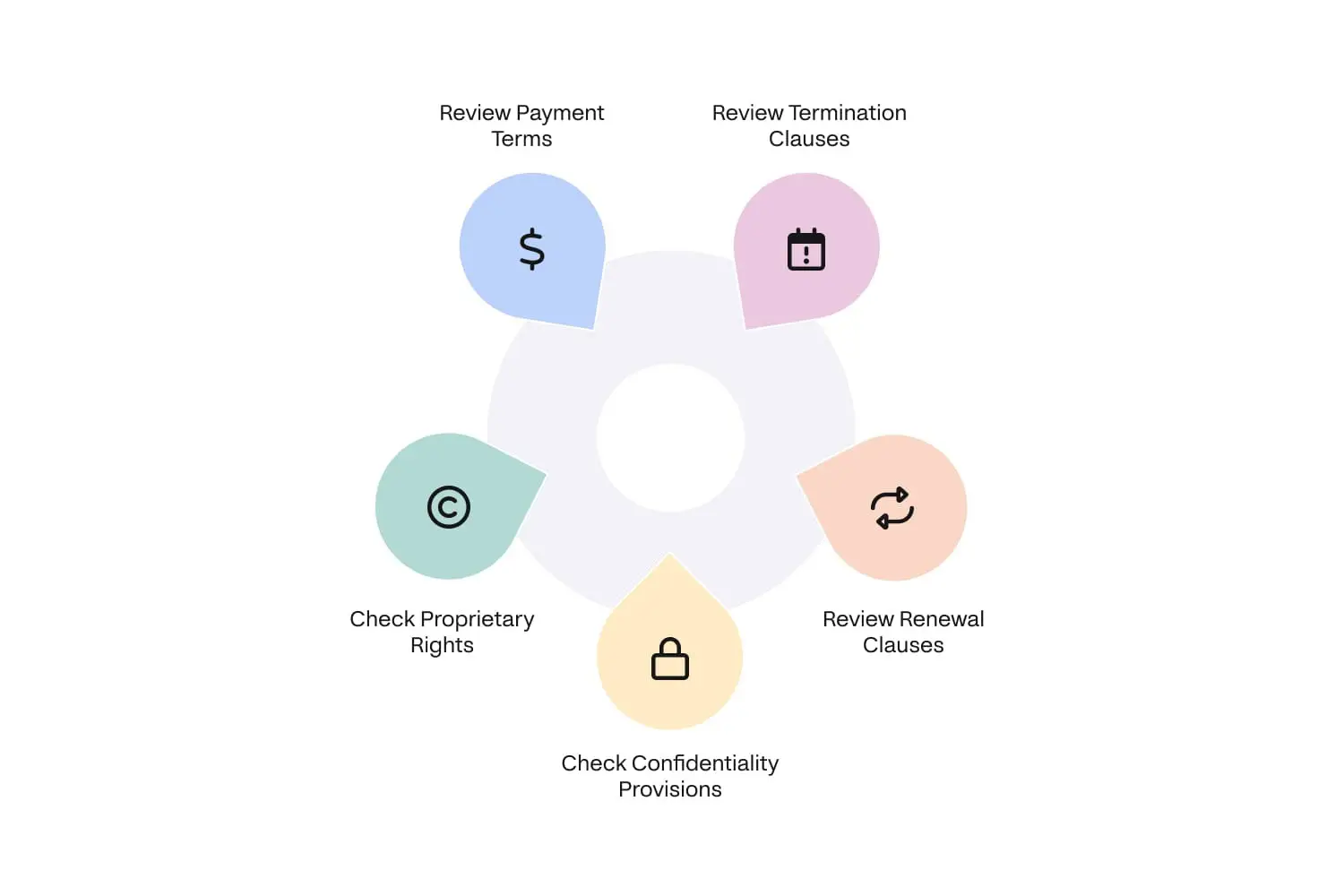
Evaluate Payment Terms and Financial Implications
Review the payment schedule, amounts, and conditions. Confirm the financial terms are clear, workable, and consistent with what was negotiated. Payment terms should reflect the agreed compensation for the products or services without ambiguity.
Check for penalties, fees, or hidden costs that could affect the overall cost and impose additional financial obligations.
Where a business-to-business contract is silent on payment period, the Late Payment of Commercial Debts (Interest) Act 1998 sets a default of 30 days. Terms beyond 60 days must be expressly agreed and must not be grossly unfair to the supplier.
Red flags in a contract are terms that shift risk without a corresponding commercial return: payment periods stretched far beyond the statutory default, confidentiality that binds one party indefinitely, intellectual property assigned on delivery rather than on payment, and indemnities with no liability cap.
Review Renewal, Modification and Termination Clauses
Understand the conditions under which the contract can be ended, extended, or changed by reviewing the termination clauses and the provisions for renewal and modification. Knowing these terms tells you how much flexibility the agreement actually gives you.
Confirm any amendments to contract terms are agreed by all parties and documented, to prevent unwanted obligations or disputes when the contract ends.
Check Confidentiality and Intellectual Property Provisions
Confirm the clauses protecting sensitive information and proprietary rights are comprehensive. Check that your confidential data and intellectual property are safeguarded against unauthorised use or disclosure.
Review how breaches of confidentiality will be handled and what remedies are available. These clauses are the ones that matter most for trade secrets and sensitive business information.
4. How AI-Assisted Contract Review Works
The first pass : reading a contract end to end, marking anything unfamiliar, and comparing it against what your organisation normally accepts : is the part of review that is now largely automated. The judgement that surrounds it is not.
That distinction matters when reading claims about AI contract review. The technology has not replaced the reviewer. It has removed the mechanical comparison work that used to consume most of the reviewer’s time.
Review Against a Contract Playbook
A contract playbook is a document that records, clause by clause, the position your organisation prefers, the fallback positions it will accept, and the point at which a term must be escalated. Most organisations negotiate from an informal version of this held in a few people’s heads.
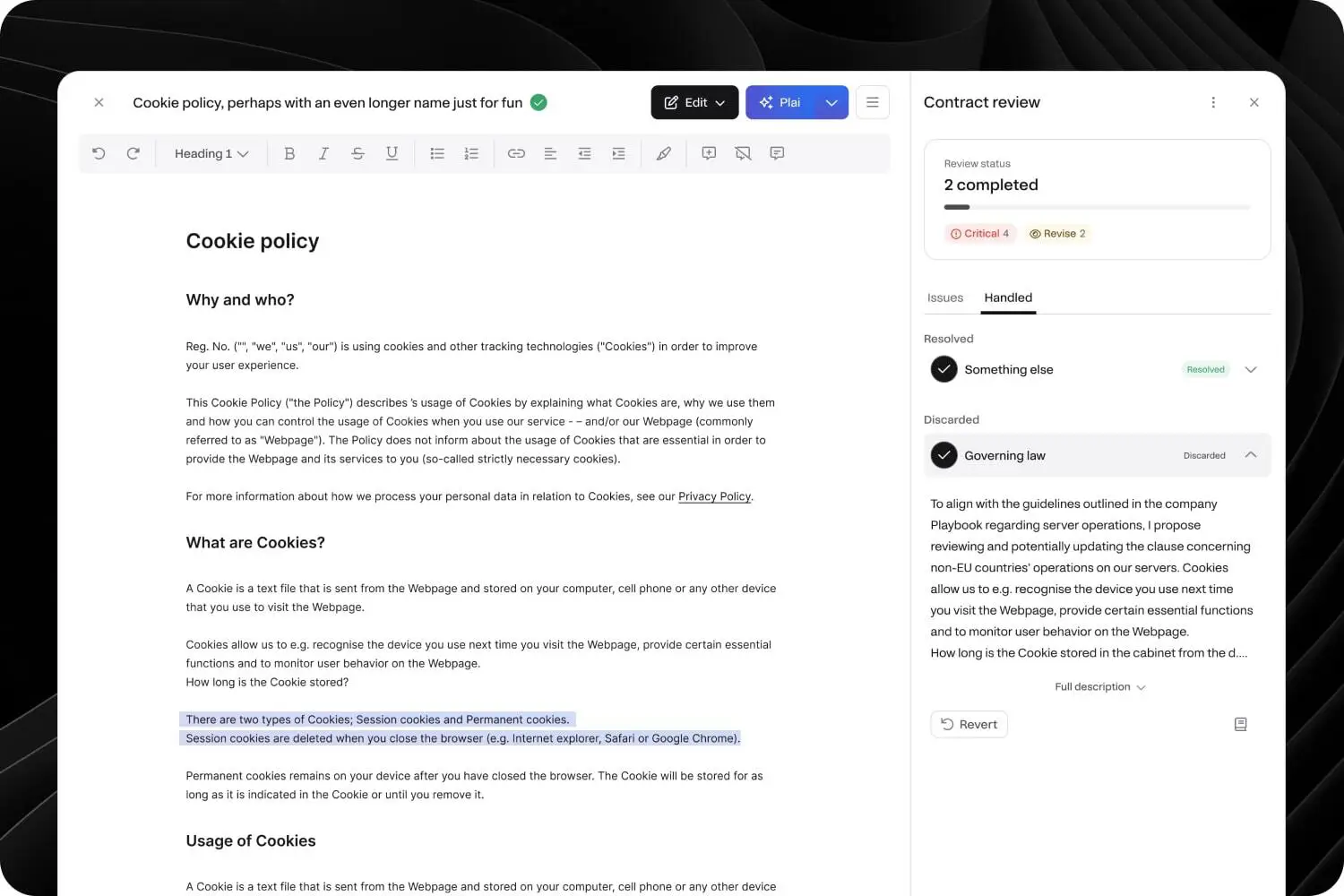
AI contract review works by comparing every clause in an agreement against an encoded playbook rather than against generic notions of risk. Each clause returns a verdict : accept as drafted, propose an alternative, or escalate : and the alternative wording comes from positions the organisation has already approved.
PLAI, Miramis’s AI contract agent, operates this way. Every contract is checked against the company’s own templates and playbooks, each flag is traceable back to the source clause it came from, and suggested alternatives are drawn from that playbook rather than generated freely.
This runs in both directions. Incoming counterparty paper is checked for terms that fall outside what the organisation accepts. Outgoing templates are checked for drift : clauses that have been edited over time until they no longer match the approved position.
Review Across the Whole Contract Portfolio
There is a second category of review question that manual reading cannot answer at all: which of our 400 supplier agreements cap liability below annual contract value, which auto-renew within the next 90 days, and which lack a data processing clause.
Answering that is a different operation from reviewing one contract. Many agreements are read at once, the same questions are asked of each, and the results are returned as one comparable table rather than as 400 separate readings.
PLAI’s tabular review does this: any number of contracts reviewed simultaneously, with the results structured into a single comparable table that can be exported as a CSV file. The practical use is not speed on a single agreement : it is answering a portfolio question before a renewal date or an audit forces the issue.
What AI Contract Review Cannot Do
AI can review contracts accurately when the playbook it compares against is complete and current. Accuracy is a property of the standard, not of the model. An outdated playbook produces confident, consistent review against the wrong position : which is harder to catch than an obvious error.
Several parts of review remain human. AI does not decide whether a deal is commercially worth doing, and it cannot weigh bargaining power or the value of a long-standing relationship against a term you would otherwise reject.
It also handles genuinely novel drafting poorly. A first-of-kind agreement has no playbook position to compare against, so there is no standard for the review to apply. Nothing produced by an AI review constitutes legal advice.
The useful framing is division of labour. Automated review narrows a 40-page agreement to the four or five terms that actually need a decision. A person still makes the decision, and remains accountable for it.
5. Ensure Legal Compliance and Address Potential Disputes
Verify the contract adheres to all applicable laws and regulations. Non-compliance can lead to legal disputes and financial penalties. Consulting a solicitor confirms the agreement complies with contract law, is legally binding, and is enforceable.
Verify Governing Law and Jurisdiction
Check which laws govern the contract and where disputes will be resolved. Jurisdiction affects both interpretation and enforcement. Laws differ between the UK and the US, for example, changing what remedies are available and how obligations are read.
Being aware of these differences helps you assess risk and understand how a dispute would actually be handled. Confirm the dispute resolution clause is practical for all parties, not only acceptable in principle.
Ensure Compliance with Business and Industry Standards
Confirm the contract aligns with industry regulations and your company’s own policies. Compliance avoids regulatory fines and keeps commitments consistent across the agreements the business signs.
Check that all contractual obligations meet regulatory requirements and that the legal documents are drafted accordingly. This reduces legal risk and supports trust with clients and partners.
6. Address Technical Aspects of Contract Review
Pay attention to the formalities and the tools that carry the agreement through execution. Technical details determine validity as much as commercial terms do.
Review signature blocks and execution formalities to confirm all parties can legally sign the agreement. Proper execution is what makes the contract binding and enforceable.
With electronic contracts now standard, execution is usually digital. Electronic signature software supports secure signing while meeting the legal requirements that apply to e-signatures, including eIDAS standards across the EU.
7. Develop Negotiation Strategies
Prepare to address the terms that need modification before you raise them. Reviewing and negotiating clauses is what brings the agreement into line with your interests while keeping it acceptable to the other side.
To negotiate effectively, identify the clauses requiring adjustment or clarification, then propose alternative terms that protect your position while addressing the other party’s needs. Contract negotiation works better when the alternative is drafted, not merely requested.
Present your points clearly and listen to the other party’s reasoning. Understanding why a counterparty holds a position usually reveals a solution that works for both sides : which is faster than arguing the original wording.
Track changes across versions as they are exchanged. Contract redlining software keeps every amendment visible and attributable, so the version being signed is demonstrably the version that was agreed.
8. Conduct Final Review and Approval with a Solicitor or Lawyer
Before finalising, confirm all issues are resolved and the contract is ready for execution.
Perform a thorough final review with your legal team or in-house counsel to catch overlooked errors or ambiguities. This confirms all agreed changes are reflected and that the contract remains internally consistent after several rounds of edits.
Legal teams and advisers confirm the legal aspects are covered at this stage. They identify remaining risks, verify compliance, and confirm the terms are enforceable. A solicitor or in-house legal team should see the final version before it is signed.
Approval authority is part of this step and is often the part that fails. Delegation of Authority is the matrix setting out who may approve which commitments at which values, and who is authorised to sign. A contract approved by someone without that authority is a governance failure even when every term is sound.
This routing increasingly runs on its own: approval requests, reminders, and signatures are timestamped in an audit trail without anyone manually chasing them. Contract management platforms such as Miramis CLM are built around exactly this kind of workflow. Signing the contract then completes the formalities.
9. Manage Post-Review Processes
Contracts should be reviewed at least annually, and on any material change: a regulatory shift, a corporate restructure, a change of counterparty ownership, or a change in how the service is delivered in practice. Regular review identifies where an amendment is needed before the gap causes a dispute.
Handle amendments promptly and keep oversight of the contract through its lifecycle. Monitoring performance and compliance confirms all parties are meeting their obligations.
The obstacle to periodic review is usually retrieval rather than diligence. Contracts held across email, shared drives, and personal folders cannot be re-reviewed, because nobody can locate them or say what they contain. A contract repository with extracted metadata is what makes post-signature review possible at all.
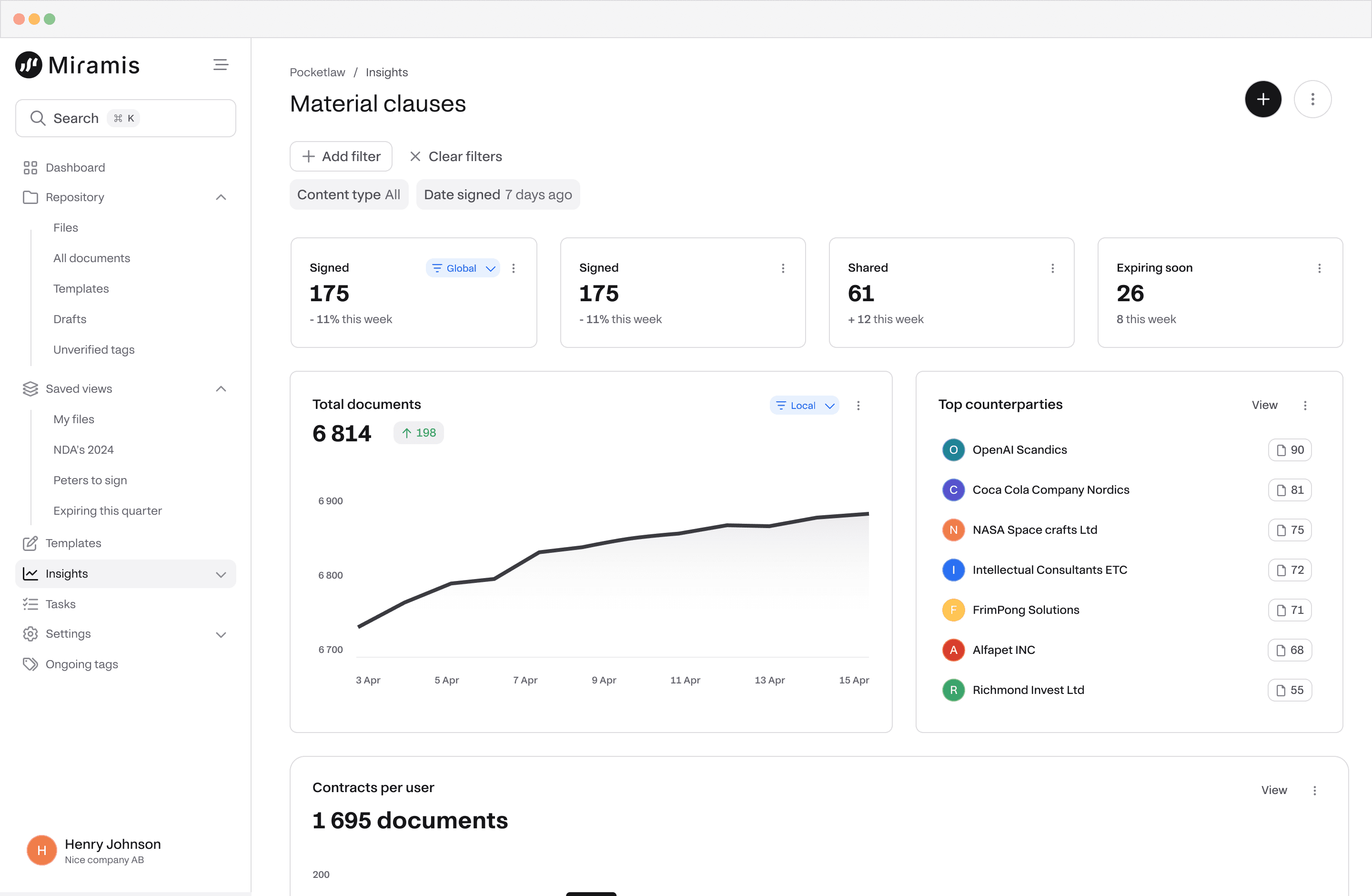
Tools built for this stage automate the parts that used to require opening files one by one: compliance checks, deadline tracking, and flags for risks such as potential breaches or inconsistencies. Platforms like Miramis pair this repository with PLAI, an AI agent that answers plain-language questions across the full archive at once, surfacing amendment opportunities and improving transparency across the portfolio.
Contract monitoring then runs continuously rather than periodically. Renewal dates, notice windows, and obligation deadlines are surfaced before they pass, which is the failure mode that turns a well-reviewed contract into an unintended five-year commitment.
Portfolio-level visibility is also where the cost of not doing this shows up. World Commerce & Contracting’s AI and the Contract Management Lifecycle report, published in December 2024, put average value erosion across contracts at 8.6%, most of it invisible until someone goes looking.

Disclaimer:
Please note: Miramis is not a substitute for an attorney or law firm. So, should you have any legal questions on the content of this page, please get in touch with a qualified legal professional.
Related articles

Aleatory Contracts Explained: Types and Industry Use Copy
An aleatory contract is a binding agreement where obligations and benefits depend on uncertain future events, like insurance or gambling contracts.

10 ChatGPT Use Cases for Lawyers & Legal Teams
Discover how ChatGPT enhances legal research, drafting, and compliance while understanding its limitations and the best ways to use AI effectively in legal practice.

Executed Contracts: From Signing to Management
Executed contracts are legally binding agreements signed by all parties, confirming terms and ensuring smooth business transactions and partnerships.